
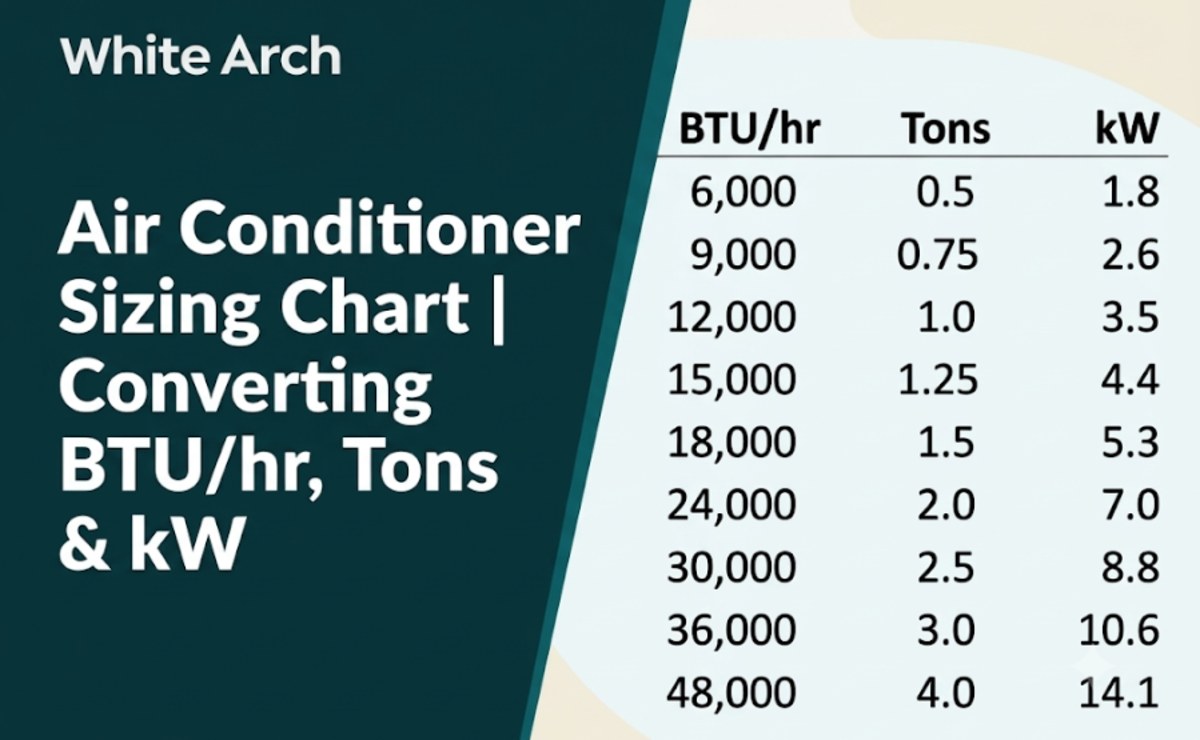
To convert kilowatts to BTU per hour, multiply the kilowatt figure by 3,412, because 1 kW equals 3,412 BTU/h. To convert kilowatts to tons of refrigeration, divide the kilowatt figure by 3.517, because 1 ton equals 12,000 BTU/h and 3.517 kW. To go the other way, multiply tons by 3.517 to get kW, or by 12,000 to get BTU/h. These three constants cover almost every chiller and cooling capacity conversion on a commercial project.
Conversion table
| From | To | Multiply by | Example |
|---|---|---|---|
| kW | BTU/h | 3,412 | 100 kW = 341,200 BTU/h |
| kW | tons (TR) | 0.2843 (divide by 3.517) | 100 kW = 28.4 tons |
| tons (TR) | kW | 3.517 | 100 tons = 351.7 kW |
| tons (TR) | BTU/h | 12,000 | 100 tons = 1,200,000 BTU/h |
| BTU/h | kW | 0.000293 (divide by 3,412) | 1,200,000 BTU/h = 351.7 kW |
Worked example, a 500 kW chilled water duty:
- kW to BTU/h: 500 x 3,412 = 1,706,000 BTU/h
- kW to tons: 500 / 3.517 = 142.2 tons
- Check, tons back to kW: 142.2 x 3.517 = 500 kW
Why the kw to btu conversion matters
The kw to btu conversion is the bridge between the units a consultant designs in and the units a chiller is sold in. A kw to btu conversion multiplies a kilowatt cooling duty by 3,412 to reach BTU per hour, the imperial heat flow unit still printed on many compressor and cooling tower data sheets. Across Saudi Arabia most MEP calculations are produced in kW, yet equipment schedules, vendor catalogs and district cooling contracts often mix kW, BTU/h and tons, so a dependable kw to btu conversion habit stops the capacity errors that surface only at commissioning.
This guide is written for facility managers, MEP consultants and developers checking plant capacity on commercial towers, hospitals, data centers, malls and campuses. It sets out the kw to btu conversion alongside the kw to tons conversion and the tons to kw conversion in one table, shows where the 3,412 and 3.517 constants come from, and links capacity to chiller tonnage calculation and airflow so that figures from different vendors can be compared on one basis. Every value below is a standard engineering constant or a direct calculation from one; project values must still be confirmed against the current ASHRAE handbook, AHRI standard and Saudi Building Code edition in force. White Arch applies these conversions during HVAC design and installation so that selected plant matches the calculated duty.
Where the constants come from
Three fixed relationships define every conversion on this page. The ton of refrigeration is defined as the rate of heat removal to freeze one short ton of water in 24 hours, which works out to 12,000 BTU per hour. The watt is defined so that 1 kW equals 3,412.14 BTU/h, and dividing 12,000 by 3,412.14 gives 3.5169 kW per ton, rounded to 3.517 for daily use.
| Relationship | Exact value | Rounded working value |
|---|---|---|
| 1 ton of refrigeration | 12,000 BTU/h | 12,000 BTU/h |
| 1 kW | 3,412.14 BTU/h | 3,412 BTU/h |
| 1 ton of refrigeration | 3.5169 kW | 3.517 kW |
| 1 kW | 0.28435 tons | 0.2843 tons |
Because these are definitions, not measurements, the only judgment is how many decimal places to carry. On a small terminal unit the rounding is irrelevant; on a 5,000 kW central plant the difference between 3.5 and 3.517 kW per ton is tens of tons, so the more precise constant is used for plant selection.

Also read: BTU to Ton Conversion: Table, Formula and Chiller kW per Ton
kW to tons conversion and tons to kW conversion in practice
The kw to tons conversion is the step that most often decides which catalog unit is chosen. A duty calculated at 420 kW divides by 3.517 to give 119.4 tons, which points to a 120 ton unit rather than a 125 ton one, a selection that affects footprint, electrical supply and part load efficiency. The tons to kw conversion runs the opposite way for verification: a nominal 350 ton chiller multiplied by 3.517 is 1,231 kW of nominal cooling capacity, which can then be checked against the design block load.
A chiller sizing calculation never stops at the kw to tons conversion or the tons to kw conversion alone; nominal capacity is not the same as duty at site conditions. Chiller ratings are published at standard chilled water and condenser temperatures, so a chiller rated for 1,231 kW at standard conditions may deliver less when condenser water is warm, which is the usual case at a cooling tower in the Eastern Province summer. For this reason the conversion fixes the arithmetic, but the selection still depends on the rated performance at the project design temperatures. White Arch coordinates this check as part of turnkey HVAC and cooling solutions.
Also read: Cooling Load Calculation for Buildings in Saudi Arabia
Chiller tonnage calculation, chiller sizing calculation and airflow
A chiller tonnage calculation, the core of any chiller sizing calculation, starts from the building cooling load, not from floor area, and the conversions above turn that load into a plant selection. Once the tonnage is set, the air side follows: a common rule of thumb is roughly 400 cubic feet per minute of supply air per ton, which in SI terms is about 188 liters per second per ton, although the exact figure depends on the supply air temperature and the sensible to total load ratio.
| Capacity | kW | Tons | BTU/h | Indicative airflow at 400 cfm/ton |
|---|---|---|---|---|
| Small AHU | 35 | 10 | 120,000 | 4,000 cfm |
| Floor plant | 176 | 50 | 600,000 | 20,000 cfm |
| Tower riser | 352 | 100 | 1,200,000 | 40,000 cfm |
| Central plant | 1,759 | 500 | 6,000,000 | 200,000 cfm |
The cfm per ton figure is an airflow check, not a sizing method; the real supply airflow comes from the sensible load and the chosen supply air temperature. Treating 400 cfm per ton as a hard rule in a high latent coastal climate can undersize dehumidification, so the airflow should always be confirmed against the psychrometric design.

Common conversion mistakes
- Using 3.5 instead of 3.517 kW per ton on large plant: The shortcut understates kW by about half a percent, which is tens of kW on a central plant and can tip a borderline selection.
- Confusing cooling kW with electrical kW: A chiller's cooling duty in kW is the heat removed, not the power it draws; the two are linked by efficiency, not equal.
- Mixing nominal and site ratings: Converting a nominal tonnage to kW and treating it as the available duty at warm condenser water overstates real capacity.
- Treating 400 cfm per ton as a design rule: In humid coastal cities the airflow must follow the sensible load, not a fixed cfm per ton.
- Rounding too early: Rounding tons before multiplying back to kW accumulates error across a multi chiller plant schedule.
Also read: Signs Your Chiller Needs Replacing: Repair, Retrofit or Replace
Capacity review for chiller plants in Saudi Arabia
For new projects, these conversions underpin the design basis that sets chiller, pump, pipe and electrical sizing. For retrofits and plant replacement, converting logged operating data into consistent units often shows that an existing plant was oversized, or that its nominal tonnage never matched the duty at local condenser conditions. As part of every chiller sizing calculation, White Arch reviews plant capacity during design and build, chiller replacement and retrofit work, coordinating the converted figures with chiller selection, chilled water distribution and electrical capacity across the markets White Arch serves. The reference constants and refrigeration definitions are maintained by ASHRAE.