
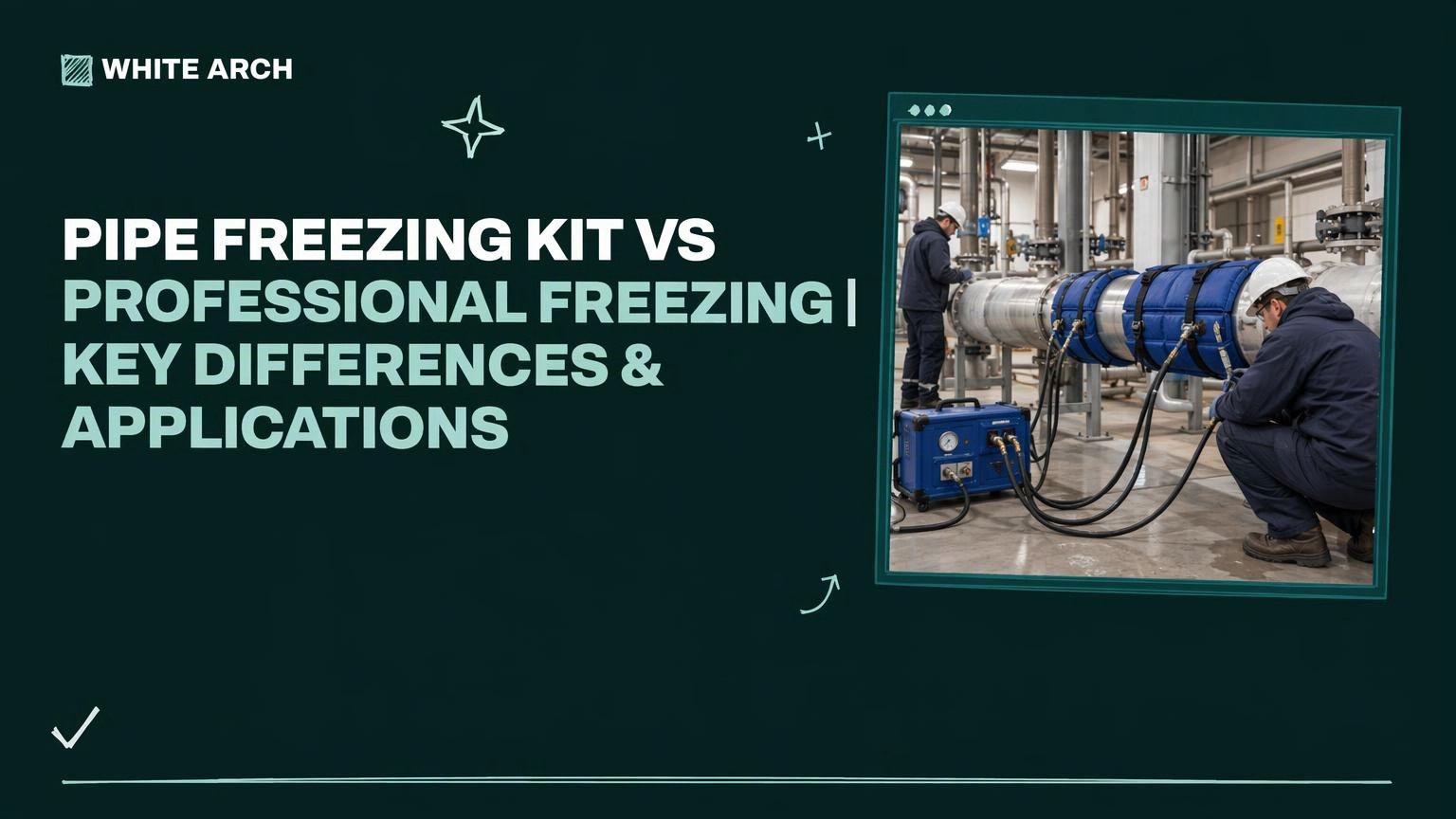
A pipe freezing kit is a small portable tool that sprays refrigerant onto a water-filled pipe to form a temporary ice plug, letting a valve or fitting be changed without draining the system. These kits are built for small copper or plastic domestic lines, usually up to about 42 mm, and reach only moderate sub-zero temperatures. Large-bore steel lines, live systems with flow, and chilled water circuits dosed with glycol sit outside what a consumer kit can safely do, which is why industrial and commercial work uses engineered liquid nitrogen pipe freezing with oxygen monitoring and a method statement.
What a pipe freezing kit is (and is not)
A pipe freezing kit is a portable device that freezes the static water inside a pipe to form a solid ice plug, so a downstream valve, pump or branch can be worked on without draining the whole system. A trade or consumer pipe freezing kit almost always uses a refrigerant spray or a pair of clamp-on jackets fed from an aerosol can, which pulls the pipe wall down to roughly minus 40 to minus 55 degrees Celsius. That temperature is enough to freeze clean water in a thin-walled copper or plastic pipe of small diameter, and the appeal of a pipe freezing kit is obvious: it is light to carry, quick to apply on a 15 mm or 22 mm line, and avoids draining and refilling a domestic circuit.
The limits start the moment the line stops being a small, clean, static water pipe. A pipe freezing kit has a narrow working envelope, typically quoted by makers up to about 42 mm outside diameter, and it assumes pure water with no flow and no antifreeze. On a large steel header, a live circuit that is still moving water, or a glycol-dosed chilled water loop, a consumer pipe freezing kit cannot pull enough heat out fast enough to form a reliable plug, and a partial plug that blows out under pressure is a serious safety event. This is the core difference between a pipe freezing kit and professional pipe freezing: the kit is a domestic convenience tool, while professional work is an engineered isolation performed on systems where failure has real consequences.
How ice plug pipe freezing actually works
Ice plug pipe freezing works by removing heat from a fixed section of pipe until the water inside turns to ice and bonds to the pipe wall, creating a pressure-tight seal on both sides of the work. The plug only forms where the fluid is static: if water keeps moving through the pipe, it keeps carrying heat into the freeze zone and the plug never sets. For this reason any freeze, from a small kit to a nitrogen rig, needs the circulating pumps stopped and the section genuinely dead-legged before freezing begins.
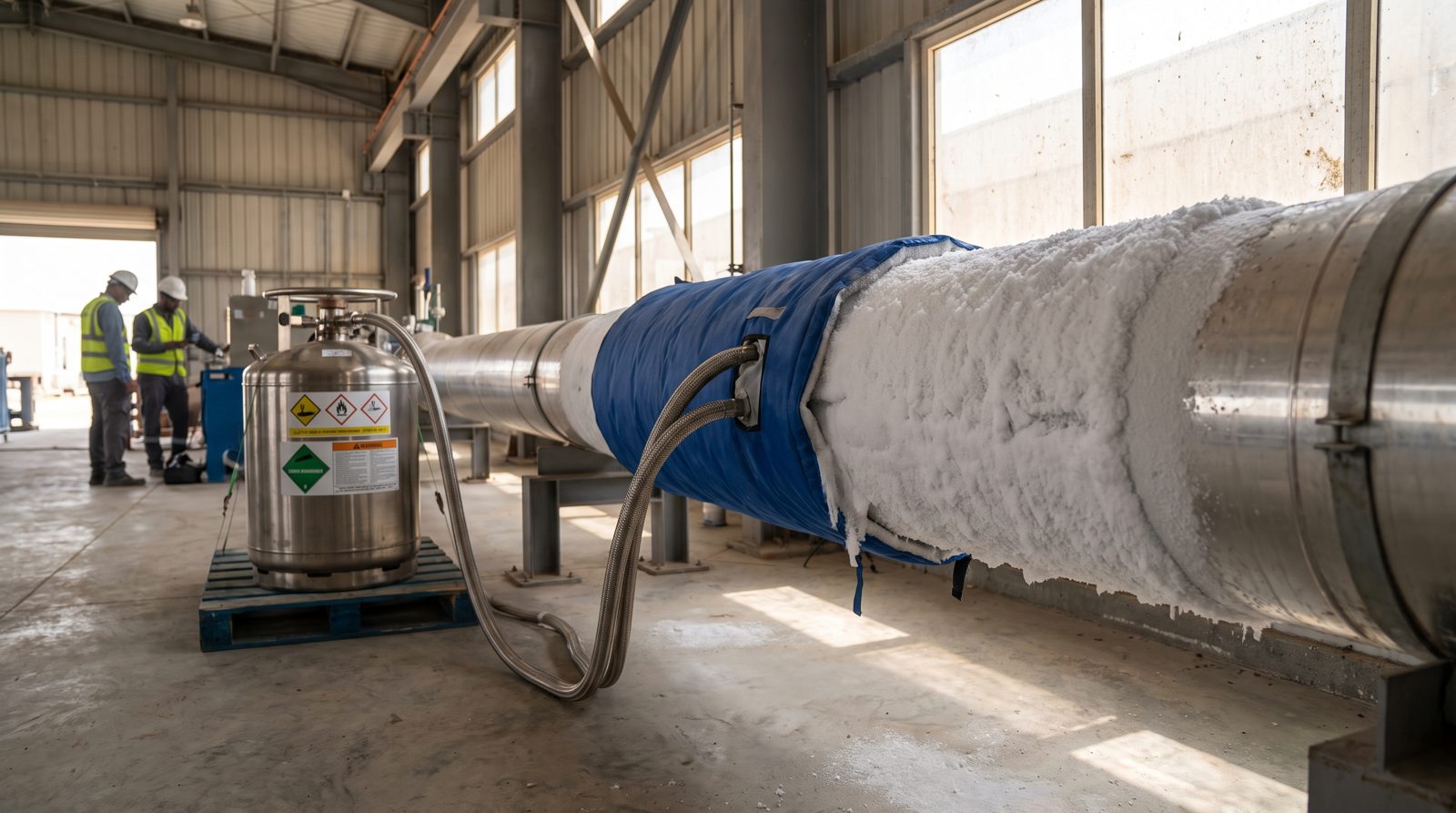
The freeze medium decides the scale. A consumer kit relies on an expanding refrigerant gas; a professional rig circulates liquid nitrogen, which boils at about minus 196 degrees Celsius, through an insulated freeze jacket clamped to the pipe. That enormous temperature difference is what lets nitrogen freezing form a plug on heavy-wall carbon steel and on large diameters that no aerosol kit can touch. Freeze time rises sharply with diameter and wall thickness, with pipe material (steel conducts differently from copper or plastic), and with the starting temperature and chemistry of the fluid.
Pipe freezing temperature and the glycol problem
Pipe freezing temperature is the central technical variable, and it is where consumer kits meet their hardest limit. Pure water freezes at 0 degrees Celsius, so a kit reaching minus 40 degrees Celsius has useful margin on a clean domestic line. Chilled water systems, however, are frequently dosed with ethylene or propylene glycol to prevent freezing in coils and outdoor sections, and glycol depresses the freezing point of the fluid. A loop at 30 percent glycol may not freeze until roughly minus 15 degrees Celsius or lower, which shrinks the margin a refrigerant kit has and can make a stable plug impossible to form within a safe time.
This is why glycol-dosed chilled water and condenser water loops are poor candidates for a pipe freezing kit even when the pipe size looks modest. A liquid nitrogen rig, with a pipe freezing temperature far below any realistic glycol freeze point, keeps a wide safety margin and can still form a dependable plug. The practical rule is simple: the lower and more variable the fluid freezing point, the more the job moves away from a kit and toward engineered nitrogen pipe freezing. White Arch confirms fluid chemistry and glycol concentration during the technical survey before any freeze is attempted, and these specialist methods are part of the solutions White Arch offers.
Pipe freezing equipment: kit vs professional rig
Pipe freezing equipment spans a wide range, from a hardware-store aerosol kit to a fully instrumented nitrogen system. The table below sets out the practical differences for the lines that matter on commercial and industrial sites.
| Factor | Consumer or trade kit | Professional nitrogen rig |
|---|---|---|
| Freeze medium | Refrigerant spray or aerosol | Liquid nitrogen at about minus 196 Celsius |
| Typical pipe size | Up to about 42 mm copper or plastic | Small bore up to large-diameter steel headers |
| Fluid suited to | Clean static water | Water, condenser water, and glycol-dosed chilled water |
| Instrumentation | None or a basic surface reading | Pipe surface thermocouples, plug monitoring, timed freeze |
| Confined-space safety | Not addressed | Oxygen depletion monitoring and ventilation |
| Documentation | None | Method statement, permit to work, contingency plan |
The gap is not only about cold. A professional setup treats the freeze as a controlled engineering operation: the pipe surface is monitored with thermocouples so the crew knows the plug has formed, the freeze is held for the full duration of the work, and a contingency plan covers what happens if pressure or temperature drifts. A pipe freezing kit offers none of that oversight, which is acceptable on a 15 mm domestic supply and unacceptable on a live building riser.

Nitrogen pipe freezing procedure on live systems
A nitrogen pipe freezing procedure on a commercial or industrial system is a sequence of controlled steps, not a single spray. White Arch follows a survey-first method on every live freeze:
- Technical survey: confirm pipe material, diameter, wall thickness, fluid type and glycol content, and verify that the section can be made static.
- Isolation and dead-legging: stop the circulating pumps and confirm there is no flow through the freeze zone, because a plug cannot form against moving fluid.
- Freeze jacket fitting: clamp insulated jackets to the pipe and connect them to the liquid nitrogen supply, with thermocouples on the pipe surface.
- Plug formation and monitoring: feed nitrogen until the surface temperature and plug behavior confirm a solid, pressure-tight ice plug on each side of the work.
- Work and controlled thaw: carry out the valve change or branch work with the plug held, then thaw in a controlled way and recommission the line.
Running through this, the risks a consumer kit ignores become clear. Nitrogen displaces oxygen, so confined or poorly ventilated plant rooms need oxygen monitoring to prevent asphyxiation. Extreme cold can embrittle some pipe materials and weld zones, so material suitability is checked before freezing. And a freeze that is released too early, or a plug that was never fully formed, can let a pressurized line discharge. Live-line isolation on building services belongs with crews who hold these controls, which is why White Arch treats freezing as a specialist scope alongside its other HVAC services and its wider contracting services.
When a pipe freezing kit is reasonable, and when it is not
A pipe freezing kit is a sensible tool for a plumber working on a small, clean, static domestic water line where a short valve change does not justify draining the system. Within its rated size and on pure water, it does what it claims.
It stops being reasonable when any of the following is true: the pipe is larger than the kit rating, the fluid is still flowing, the system is a fire main or a chilled or condenser water loop, the fluid contains glycol, the work is in a confined plant space, or the consequences of a failed plug are significant. On commercial towers, hospitals, data centers and industrial facilities, most freezes fall into that second category, and the right answer is an engineered nitrogen freeze with full documentation rather than a hardware kit.