
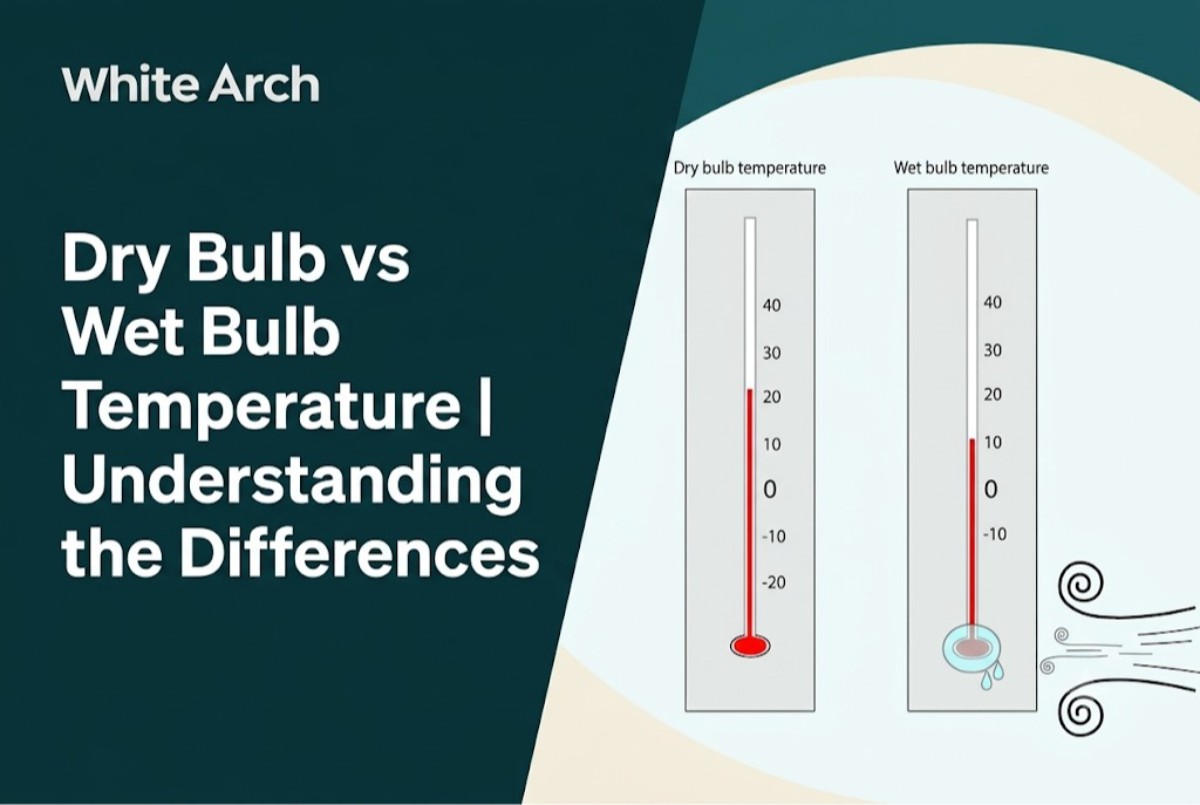
Wet bulb temperature is the lowest temperature that air can reach when water evaporates into it at constant pressure, read from a thermometer whose bulb is covered by a wet wick in moving air. It is always equal to or below the dry bulb (ordinary air) temperature, and the two are equal only when the air is fully saturated. In cooling engineering the wet bulb sets the coldest water a cooling tower can deliver and the condensing performance of a water-cooled chiller, which is why it matters so much more than dry bulb temperature in humid coastal cities such as Dammam and Khobar.
- What is wet bulb temperature
- Dry bulb, wet bulb and dew point
- The psychrometric chart explained
- How wet bulb temperature controls cooling tower design
- Air-cooled versus water-cooled: which temperature governs
- Relative humidity calculation from wet and dry bulb
- Cooling tower makeup water calculation
- Design wet bulb for Saudi cities
What is wet bulb temperature
Wet bulb temperature is the lowest temperature that air can reach by evaporating water into it at constant pressure, measured by a thermometer whose bulb is wrapped in a wet wick and exposed to moving air. Because evaporation draws heat out of the passing air, the wet bulb temperature is always equal to or below the ordinary dry bulb reading, and the gap between the two, known as the wet bulb depression, widens as the air gets drier. In fully saturated air at 100 percent relative humidity the wet and dry bulb readings are equal, because no further evaporation can take place.
For HVAC engineers in Saudi Arabia, the wet bulb temperature is the single most important design input for any system that rejects heat by evaporation, because it sets the coldest water a cooling tower can produce and the efficiency a water-cooled chiller can reach. The design wet bulb temperature also varies sharply across the Kingdom, so the correct value must be taken from the nearest representative weather station rather than assumed. Coastal Dammam and the wider Eastern Province carry very high humidity, which holds the wet bulb temperature high even through the night, while Riyadh is extremely hot yet dry, and its summer wet bulb sits far below its dry bulb peak.
Dry bulb, wet bulb and dew point
Three temperatures describe the state of moist air, and the order between them never changes. Dry bulb is the air temperature a standard thermometer reads. Dew point is the temperature at which the air would start to condense moisture if cooled at constant pressure. The wet bulb sits between the two.
| Temperature | What it measures | Relationship |
|---|---|---|
| Dry bulb | Sensible air temperature, no moisture effect | The highest of the three |
| Wet bulb | Evaporative cooling limit of the air | Between dry bulb and dew point |
| Dew point | Saturation temperature at the current moisture content | The lowest of the three |
When air is dry, the wet bulb falls well below the dry bulb and the dew point is lower still. When air is nearly saturated, all three converge. This is why a hot, dry afternoon in Riyadh and a hot, sticky evening in Dammam can share a similar dry bulb yet behave completely differently for evaporative equipment: the Dammam air has far less capacity to absorb evaporated water, so its wet bulb stays high.
The psychrometric chart explained
The psychrometric chart is the engineer's map of moist air, and it is the fastest way to read how dry bulb, wet bulb, humidity and moisture content relate. On the chart, dry bulb temperature runs along the horizontal axis and humidity ratio (the mass of water vapor per kilogram of dry air) runs up the vertical axis. Curved lines sweeping up to the left are constant relative humidity, the top curve being 100 percent saturation. Diagonal lines running down to the right are constant wet bulb temperature, and they are very close to lines of constant enthalpy, the total heat content of the air.
Reading the chart is simple once the axes are clear. A single air condition is one point. Follow the constant wet bulb line down to the saturation curve to find the wet bulb value; follow a horizontal line left to the saturation curve to find the dew point; and read the relative humidity from the nearest curved line. For Saudi design work the chart makes the coastal problem visible at a glance: a Dammam summer point sits high and to the right, close to the saturation curve, while a Riyadh point sits low and far to the right, with a long horizontal gap to saturation.
How wet bulb temperature controls cooling tower design
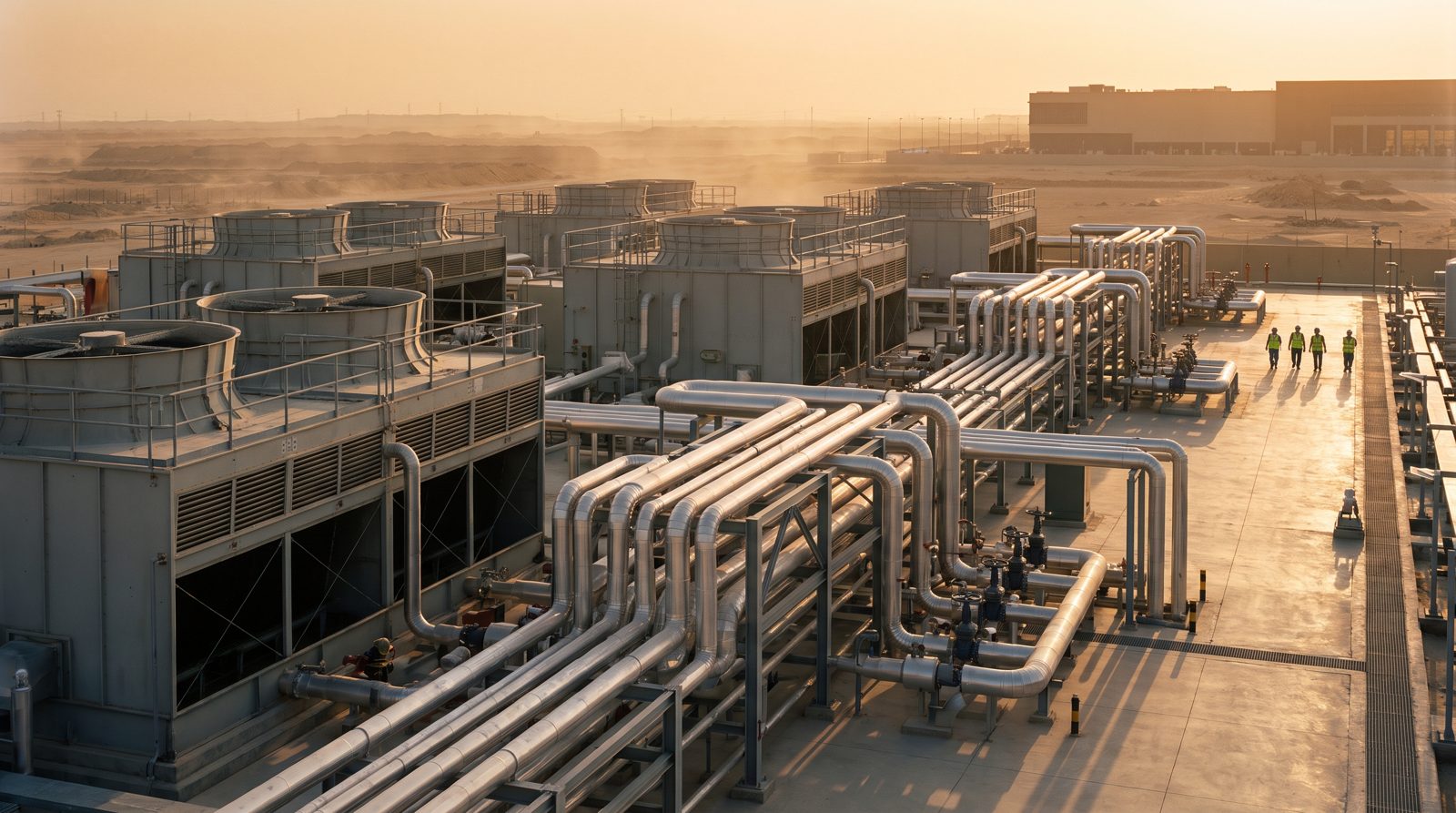
A cooling tower rejects heat by evaporating a small fraction of the circulating water, so the entering air wet bulb is the hard physical floor on how cold the water can be returned to the condenser. The water leaving a cooling tower can approach, but never reach, the ambient wet bulb temperature. Two terms describe the duty:
- Range: the temperature drop of the water across the tower, that is, entering hot water temperature minus leaving cold water temperature. Range is fixed by the heat load and the water flow, not by the weather.
- Approach: the difference between the leaving cold water temperature and the entering air wet bulb temperature. A smaller approach means a larger, more expensive tower. A typical design approach is approximately 3 to 5 degrees Celsius, confirmed against the manufacturer selection.
Because approach is measured from the wet bulb, the design wet bulb temperature chosen for a site directly sets the achievable condenser water temperature. In Dammam, a high design wet bulb means warmer condenser water, which raises the condensing pressure of a water-cooled chiller, cuts its capacity and increases its energy use. In Riyadh, the low wet bulb lets the same tower deliver colder water, so evaporative heat rejection is far more rewarding there. This is the core reason cooling tower approach and range must be set from local climatic data and not copied between cities.
Air-cooled versus water-cooled: which temperature governs
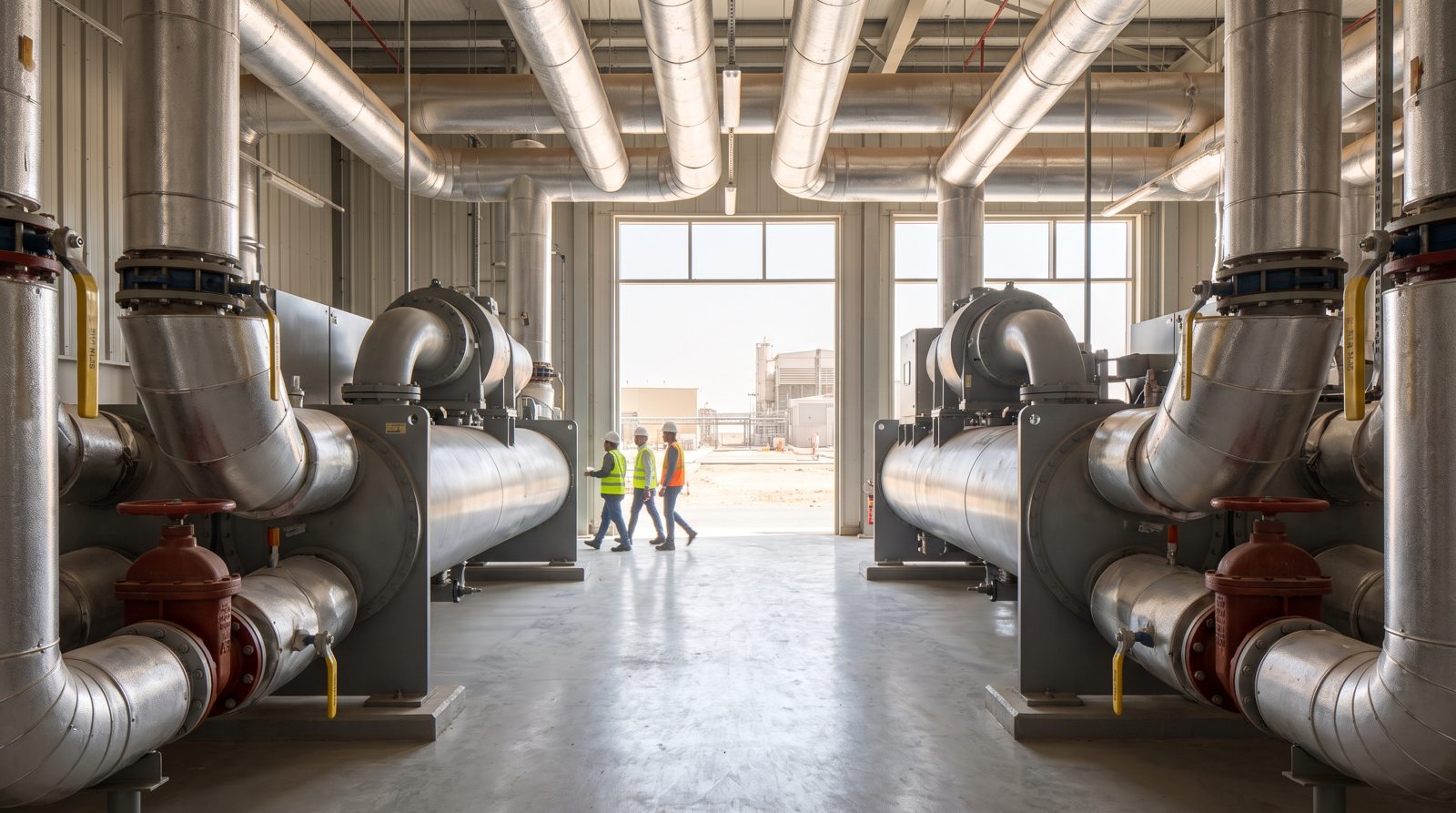
Not every system is governed by the wet bulb. An air-cooled chiller or a dry cooler rejects heat to the air by sensible heat transfer alone, so its capacity is set by the design dry bulb temperature. A water-cooled chiller paired with a cooling tower rejects heat by evaporation, so its condenser side is set by the design wet bulb temperature. The right choice for a Saudi project depends on which limit is less punishing at that location.
| System | Governing temperature | Saudi design note |
|---|---|---|
| Air-cooled chiller or dry cooler | Dry bulb | Penalized by Riyadh and inland peak dry bulb of approximately 45 to 48 degrees Celsius |
| Water-cooled chiller with cooling tower | Wet bulb | Penalized by Dammam and Eastern Province coastal wet bulb, often approximately 30 degrees Celsius or higher |
| Evaporative or adiabatic pre-cooling | Wet bulb depression | Highly effective in dry Riyadh air, far weaker in humid coastal air |
The lesson for the Kingdom is that geography decides the economics. Inland dry-climate projects can favor evaporative strategies because the wet bulb depression is large, while humid coastal projects must weigh the lifecycle energy penalty of a high condenser water temperature against the fan and condenser energy of air-cooled plant. These decisions sit alongside the cooling load calculation for the building, which fixes the total capacity the plant must reject.
Relative humidity calculation from wet and dry bulb
A relative humidity calculation starts from a paired dry bulb and wet bulb reading taken with a sling or aspirated psychrometer. The practical route is to plot both on the psychrometric chart: the intersection of the measured dry bulb vertical and the measured wet bulb diagonal fixes the air state, and the relative humidity is read off the curved line through that point. The physics behind the chart is the psychrometric relation, which balances the sensible heat given up by the air against the latent heat taken up by the evaporating water, linking the wet bulb depression to the vapor pressure and therefore to relative humidity.
The headline point for the Gulf is that a large wet bulb depression means dry air and low relative humidity, while a small depression means humid air. In Dammam, where the dry bulb and wet bulb readings are often only a few degrees apart in summer, relative humidity is very high and the moisture, or latent, load on cooling coils is severe. In Riyadh the wide depression signals low relative humidity, so the same building carries a much smaller latent load.

Cooling tower makeup water calculation
A cooling tower makeup water calculation estimates the water that must be added to replace what leaves the system, which matters because water is a scarce and regulated resource across Saudi Arabia. Makeup water has three components:
- Evaporation: the water actually boiled off to reject heat, approximately 1 percent of the circulating flow for every 5.5 degrees Celsius of range, varying with ambient wet bulb and load.
- Drift: fine droplets carried out in the air stream, held to a very small fraction of flow by modern drift eliminators.
- Blowdown: water bled off to stop dissolved solids concentrating. Blowdown is approximately the evaporation rate divided by (cycles of concentration minus one).
Total makeup water equals evaporation plus drift plus blowdown. Only the evaporation term does useful cooling; drift and blowdown are losses that good design and water treatment minimize. In the Eastern Province, high wet bulb conditions raise both the condenser water temperature and the evaporation rate at peak, so the makeup water demand and the treatment regime should be sized for the hottest, most humid design hour, not an average day.
Design wet bulb for Saudi cities
Design values should always come from the climatic design data in the ASHRAE Handbook, Fundamentals volume, for the nearest representative station, because the published figures differ by station and by edition. ASHRAE lists an evaporation design case keyed to the wet bulb at annual frequencies of 0.4, 1 and 2 percent, and that evaporation case is the correct basis for cooling tower and condenser selection.
| Location | Climate character | Approximate design wet bulb note |
|---|---|---|
| Dammam, Khobar, Dhahran | Hot with very high coastal humidity | High design wet bulb, often approximately 30 degrees Celsius or above; water-cooled plant penalized |
| Jubail and other coastal industrial sites | Hot, humid, marine air | Similar high wet bulb to the Dammam area; confirm per station |
| Riyadh and inland | Extremely hot but dry | Much lower design wet bulb despite high dry bulb; favorable for evaporative rejection |
These values are approximate and must be confirmed against the current ASHRAE climatic design data for the specific project station. White Arch coordinates heat rejection design with equipment selection, chilled-water distribution and electrical capacity through its HVAC services, delivering projects across the markets White Arch serves and supporting complex schemes through its specialist mechanical solutions. The climatic design procedures are published by ASHRAE.