
Pipe Freezing and Line Isolation Services in Saudi Arabia
We form liquid nitrogen freeze plugs that isolate a single section of chilled water, condenser water, domestic water or fire main, so valves can be replaced and branches added without draining the system.
Request proposal WhatsApp +966 57 048 3020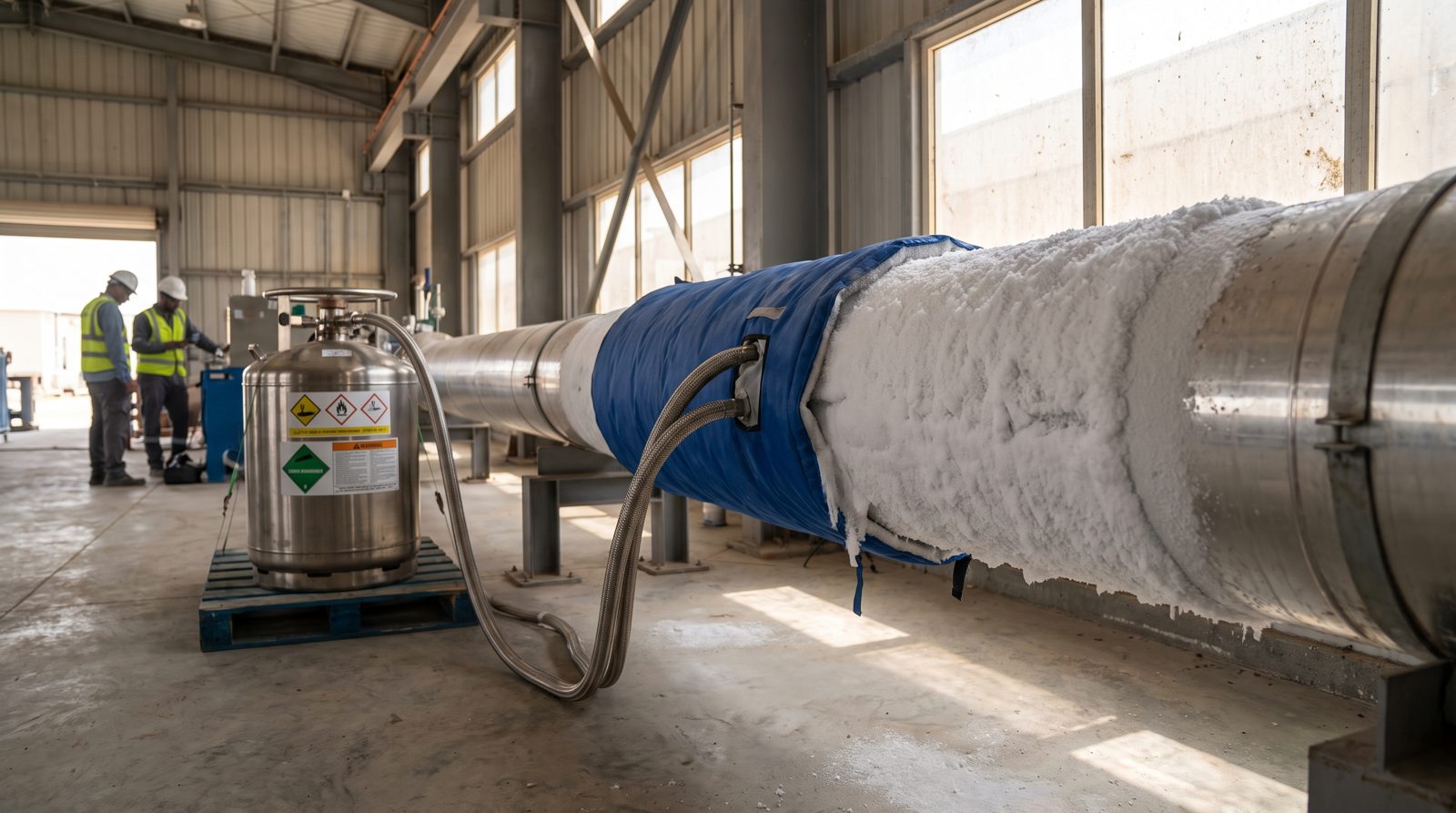
Pipe freezing is a cryogenic line isolation method: a jacket fed with liquid nitrogen is clamped around a liquid-filled pipe until the contents freeze into a solid ice plug that seals the bore. While the plug holds, a valve, strainer or pipe section can be replaced, or a branch added, without draining the system. White Arch delivers cryogenic pipe freezing services in Saudi Arabia from its Dammam base as part of its line isolation services in Saudi Arabia, with suitability confirmed at site survey.
Isolation without a drain-down
Pipe freezing services in Saudi Arabia exist because most valve, strainer and branch work on a live water system does not justify draining an entire circuit. We provide pipe freezing services across Saudi Arabia for chilled water, condenser water, domestic water and fire protection mains, isolating only the short length of pipe the work needs. Draining a chilled-water loop in a hospital, data center or mall means lost cooling, refilling, venting, chemical re-dosing and rebalancing, while a freeze plug confines the interruption to the section being worked on.
Facility managers and consultants turn to pipe freezing services in Saudi Arabia when an isolation valve is missing, passing or seized and there is no other way to stop water reaching the work point. As a provider of cryogenic pipe freezing services in Saudi Arabia, we plan each freeze as an engineered isolation with a method statement, monitoring and a contingency plan, and we mobilize from Dammam to Jubail, Al Khobar, Riyadh, Jeddah and project sites across the Kingdom. Teams looking for a pipe freezing company in Dammam can request a technical survey through our services overview or the contact page.
How a freeze plug forms
Liquid nitrogen boils at approximately minus 196 °C at atmospheric pressure. When it is fed into a jacket clamped around the pipe, it draws heat out through the pipe wall far faster than the surrounding air can replace it. Ice first forms as a thin layer on the inside of the wall, then grows inward in rings until the bore is closed by a solid plug. The nitrogen gas that boils off is vented away from the work area.
The plug resists line pressure through its length and its bond with the pipe wall, so the liquid nitrogen feed is maintained for the full duration of the work. Two conditions are essential. First, there must be no flow at the freeze point, because moving water carries heat in faster than the jacket can remove it, so circulating pumps are stopped or the section is brought to zero flow. Second, the pipe must be full of liquid at the freeze location, since an air pocket will not form a seal.
Once the plug is confirmed, the downstream section is opened, drained locally and worked on. After the work is complete and tested, the nitrogen feed is stopped and the plug is allowed to thaw under control, never with a flame or other direct heat. The numbers behind cryogenic pipe freezing services in Saudi Arabia and elsewhere are simple physical constants.
| Property | Value | Why it matters on site |
|---|---|---|
| Boiling point of liquid nitrogen | Minus 195.8 °C at atmospheric pressure | Sets how fast heat leaves the pipe wall |
| Liquid-to-gas expansion at 20 °C | About 694 to 1 | Boiled-off nitrogen displaces air, so plant rooms need ventilation (USDA ARS liquid nitrogen safety guidance) |
| Latent heat of fusion of water | About 334 kJ/kg (144 BTU/lb) | The energy that must be removed to turn water into ice |
| Latent heat of vaporization of liquid nitrogen | About 199 kJ/kg | Each kilogram of nitrogen absorbs this much heat as it boils |
| Volume increase when water freezes | About 9% | Trapped liquid between two plugs or closed valves can over-pressurize, so the isolated section is vented |
| Oxygen-deficient atmosphere | Below 19.5% oxygen by volume (OSHA) | The threshold used to set ventilation and monitoring alarms |
A simple illustration shows the scale. A 300 mm plug in a 100 mm bore holds about 2.4 kg of water, so freezing it removes about 0.8 MJ of latent heat alone. At 199 kJ/kg, boiling roughly 4 kg (about 5 liters) of liquid nitrogen is the theoretical minimum to absorb that, and real consumption is several times higher because the pipe wall, insulation and ambient heat also draw on the cold. That is why we confirm nitrogen quantity at survey instead of quoting a fixed figure.
What pipe freezing is used for
Valve replacement
Replacing a passing, seized or damaged isolation valve, check valve or control valve where no upstream valve can isolate the section.
Chilled water line isolation service
A chilled water line isolation service lets us isolate a branch of a chilled-water or condenser-water network so the rest of the plant keeps serving the building while the work proceeds.
Fire protection lines
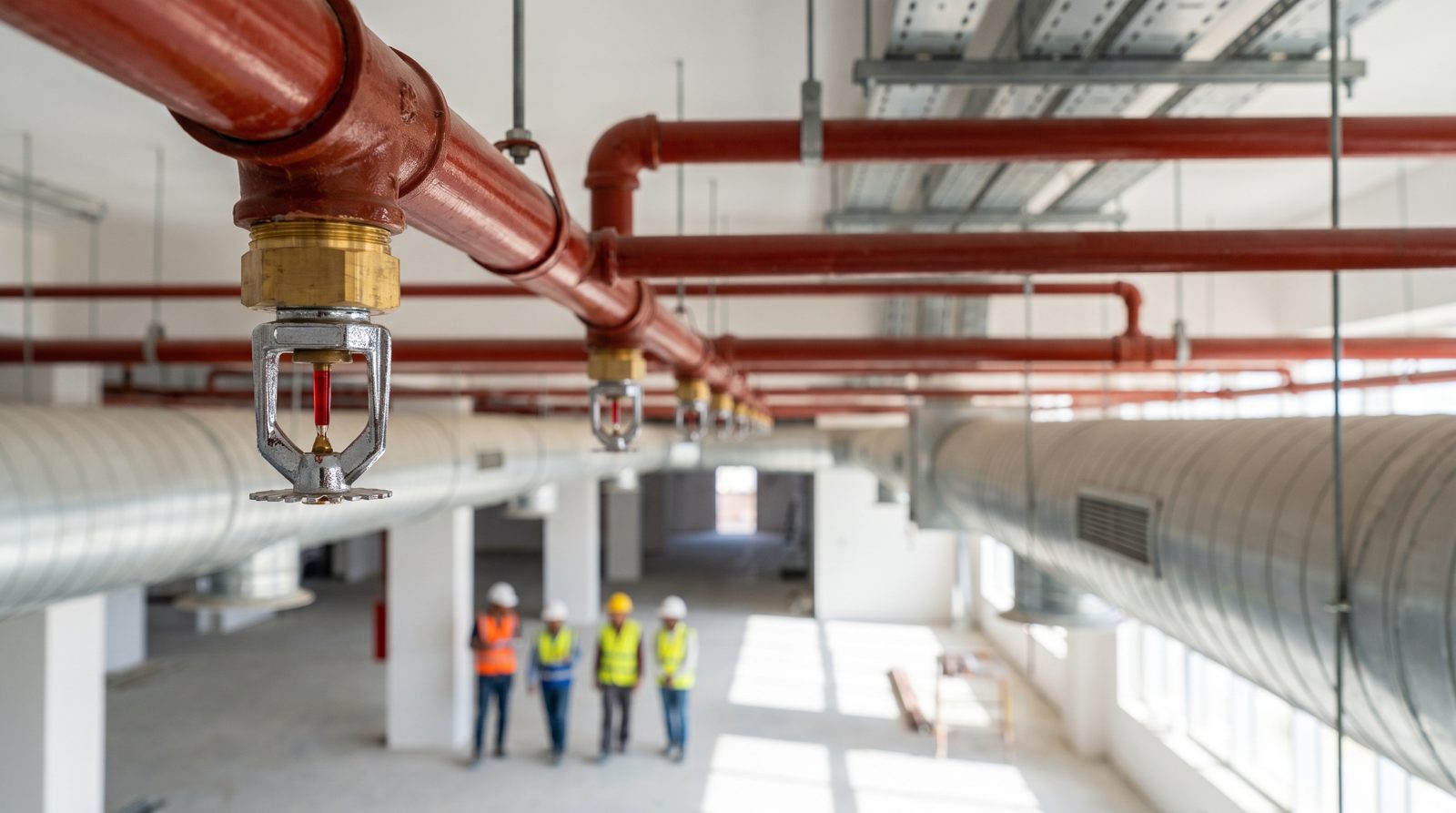
Working on fire mains, risers and sprinkler feeds while limiting the area and duration of the impairment, coordinated with the building's fire impairment procedure.
Adding branches and tie-ins
Cutting in a new tee, take-off or meter on an existing main for a fit-out, extension or new equipment connection.
Strainers, meters and PRVs
Replacing strainers, flow meters, pressure reducing valves and similar inline components that sit between remote isolation points.
Leak and damage repair
Isolating a leaking joint or damaged section quickly as part of a critical response, when draining would take a whole zone offline.
These are the line isolation services in Saudi Arabia we are asked for most often. Fire line work follows NFPA 25, which sets an impairment procedure with a designated coordinator, tagging and notification for taking water-based fire protection out of service. Pipe freezing in Jubail and across the Eastern Province follows the same method statement. Pipe freezing sits within our wider solutions and our service range.
Suitability: pipe size, material and medium
Pipe freezing is not suitable for every line, and the limits are specific to each installation. The same survey applies to pipe freezing in Jubail plants. The size that can be frozen, the time the freeze takes and the nitrogen consumed all depend on pipe size, material, flow and medium, and are confirmed at survey, not quoted in advance. The table shows what the survey checks and why.
| Factor | What the survey checks | Why it matters |
|---|---|---|
| Pipe size and wall | Nominal size, wall thickness, condition of the wall at the freeze point | Larger bores need longer freezes and more nitrogen, and thin or corroded walls need assessment before freezing |
| Pipe material | Carbon steel, stainless steel, copper, plastics, cast or ductile iron | Common metallic pipe is routinely frozen, while brittle materials such as cast iron, and some plastics, need specific assessment or may be unsuitable |
| Medium | Water, chilled water, glycol solution, other liquids | Water freezes reliably, and glycol mixtures depend on concentration and are assessed case by case |
| Flow | Whether flow at the freeze point can be stopped completely | Any flow at the jacket prevents a stable plug |
| Pressure and temperature | Static and operating pressure, fluid temperature | Determines the plug length needed and how the freeze is held |
| Location | Straight run, distance from welds, fittings, valves and heat sources | The freeze is placed on clean straight pipe, clear of joints and away from the work point |
| Access and ventilation | Space for jacket, dewar, hoses and crew, and air movement | Nitrogen gas displaces oxygen, so enclosed plant rooms need ventilation and monitoring |
Method statement and safety process
Every freeze runs under a written method statement and the site's permit-to-work system. As a pipe freezing company in Dammam, we follow the sequence below for cryogenic pipe freezing services in Saudi Arabia, and the same outline applies to pipe freezing in Jubail. The detail is set at survey and agreed with the facility owner before work starts.
Technical survey
Confirm pipe size, material, wall condition, medium, pressure, temperature, flow control and access, and select the freeze location.
Method statement and risk assessment
Define freeze location, nitrogen quantity, ventilation, oxygen monitoring, PPE, emergency arrangements and the contingency if the plug does not hold, then submit for approval and obtain permits.
Prepare the line
Stop flow at the freeze point, remove insulation and cladding at the jacket location, and protect adjacent equipment and finishes.
Fit the jacket and freeze
Clamp the jacket, connect the dewar and introduce liquid nitrogen, monitoring pipe surface temperature until the plug forms.
Verify the plug
Open a downstream drain or vent and confirm there is no passing flow before any joint is broken.
Carry out the work
Replace the valve or component, or cut in the branch, while the nitrogen feed maintains the plug, with no impact or shock loading on the frozen section.
Thaw, test and reinstate
Stop the feed, allow a controlled thaw, check new joints for leaks, reinstate insulation, restore flow and record the work for handover.
Safety controls are built around three hazards, summarized below. The wider quality and safety framework is described on our standards page.
| Hazard | What the numbers say | Control |
|---|---|---|
| Oxygen depletion | One liter of liquid nitrogen becomes about 694 liters of gas. As a calculation, boiling about 10 liters in an unventilated 100 m³ room, with complete mixing, lowers oxygen from 20.9% to the 19.5% limit | Ventilation, continuous oxygen monitoring and alarms, and no work in unventilated pits or shafts |
| Cold burns and brittle fracture | Liquid nitrogen at minus 196 °C freezes skin on contact, and carbon steel loses toughness at cryogenic temperatures | Cryogenic gloves, face shields, exclusion zones, and no impact or shock loading on a frozen pipe |
| Pressurized containers | Liquid nitrogen is held in vacuum-insulated cryogenic vessels that vent as the liquid boils | Dewars secured, vented and handled only as cryogenic containers |
Chilled water line isolation service for critical facilities
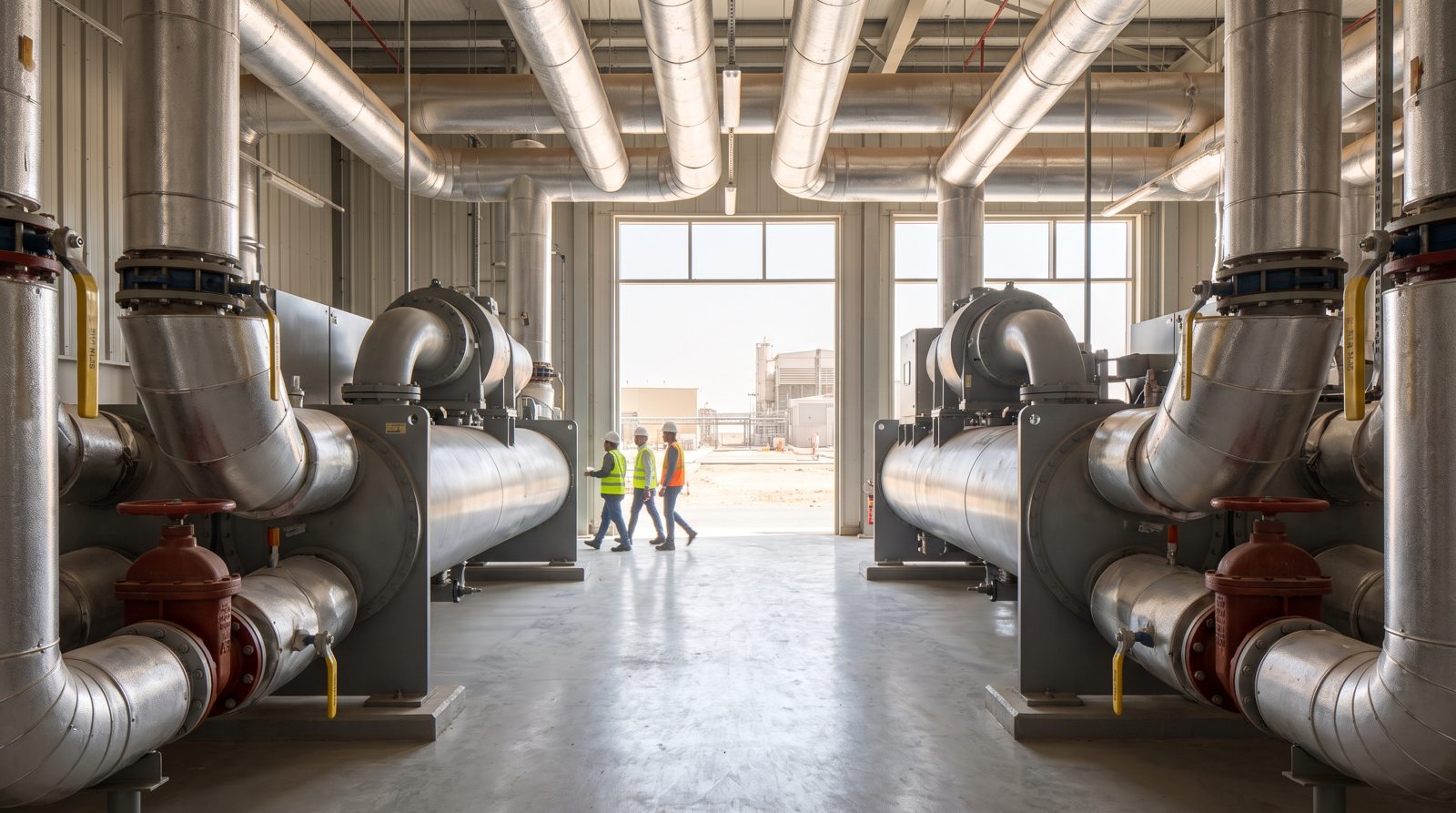
For a chilled water line isolation service in an operating building, the freeze is only one part of the plan. The plant operator needs to know which chillers, pumps and air handling units stay online, how long the isolated zone can run without cooling, and what happens if the work takes longer than planned. We coordinate the freeze with the building's operations team, sequence the work into the lowest-load period where possible, and keep a contingency plan ready, such as an available isolation point further upstream. Plant capacity during the work can be checked with the method in our BTU to ton conversion guide.
This is where pipe freezing connects to the rest of the chilled-water scope. The same team that freezes the line also handles the valve, the pipework modification and the rebalancing afterward, under our HVAC services scope, so one accountable contractor owns the isolation and the work it enables. Where a freeze accompanies a replacement, see our chiller installation and replacement page, and for plant sizing see the cooling load calculation guide.
Pipe freezing compared with other isolation methods
Our line isolation services in Saudi Arabia include more than one method, because no single method suits every line. A chilled water line isolation service most often uses a freeze, and the table compares the common options.
| Method | How the line is isolated | Typical fit |
|---|---|---|
| Drain-down | Close existing valves, drain the section or the whole system | Planned shutdowns where the system can be taken offline and valves seal properly |
| Pipe freezing | Ice plug formed by liquid nitrogen in the pipe | Water-filled lines where flow can be stopped locally and no working valve exists |
| Hot tapping and line stopping | Fitting welded or clamped on, line cut and plugged under pressure | Lines that cannot be stopped at all, or sizes and media unsuited to freezing |
Hot tapping is described on our solutions page, and both methods can be planned under one contract with the electrical and mechanical scope in our electrical and MEP services.
Pipe freezing company in Dammam, with Jubail and the Eastern Province
As a pipe freezing company in Dammam, we cover the Eastern Province first.
Pipe freezing in Jubail
Pipe freezing in Jubail is a regular request because Jubail Industrial City, established in 1975 under the Royal Commission for Jubail and Yanbu, houses thirteen of SABIC's sixteen production plants in the Kingdom and the King Fahd Industrial Port (Saudipedia, Jubail Industrial City). The Commission has also allocated SAR 67.5 billion to double the city's area by 2030. Plants of that kind run cooling water, utility water and fire water networks that cannot easily be drained, which is where pipe freezing in Jubail earns its place under the site's permit-to-work system.
| Location | Typical sites | Notes |
|---|---|---|
| Dammam | Hospitals, malls, towers and the Second Industrial City | Our headquarters, from which we work as a pipe freezing company in Dammam. The Second Industrial City was established by MODON in 1978 on 25.5 million square meters (MODON). See our HVAC contractor in Dammam and MEP contractor in Dammam pages |
| Jubail | Industrial and utility plant, port facilities | Pipe freezing in Jubail is mobilized from Dammam. The Royal Commission was established by Royal Decree on 21 September 1975 (Saudipedia, Royal Commission for Jubail and Yanbu) |
| Al Khobar and Dhahran | Offices, retail and hospitality plant | Same metropolitan area as Dammam |
| Riyadh | Commercial towers and malls | Mobilized from Dammam. See our HVAC contractor in Riyadh and MEP contractor in Riyadh pages |
| Jeddah and other sites | Commercial and institutional plant | Mobilized from Dammam, including urgent critical response |
Why clients choose White Arch
We are one accountable contractor for mechanical, electrical and specialist scopes, with submittals, QA/QC and documented handover. As a pipe freezing company in Dammam with ISO-certified management systems, we also take work in Jubail, including pipe freezing in Jubail plants. Learn more about White Arch, see the markets we serve or read our technical articles.
Frequently asked questions
How does pipe freezing work?
A jacket clamped around the pipe is fed with liquid nitrogen at approximately minus 196 °C, which freezes the liquid inside into a solid ice plug that seals the bore while the work downstream is carried out.
What pipe sizes and materials can be frozen?
Carbon steel, stainless steel and copper are commonly frozen, while cast iron, some plastics and larger bores need specific assessment. The practical limit depends on pipe size, material, flow and medium and is confirmed at survey.
Can pipe freezing be used on chilled water and fire lines?
Yes, chilled water, condenser water, domestic water and fire mains are typical applications, provided flow at the freeze point can be stopped and the fire line work follows the building's impairment procedure.
Can a chilled water line isolation service run without shutting down the plant?
Often yes. When a chilled water line isolation service can place the freeze on a branch with zero flow, the rest of the chilled-water plant keeps serving the building, and the survey confirms the isolation point, the load that stays online and a fallback isolation point further upstream.
How long does a pipe freeze take?
Freeze time depends on pipe size, material, flow, medium and site temperature, so White Arch confirms the expected duration at survey rather than quoting a fixed figure.
Are cryogenic pipe freezing services in Saudi Arabia safe in an enclosed plant room?
They are carried out safely when the method statement covers ventilation and continuous oxygen monitoring, because nitrogen gas displaces oxygen and OSHA treats air below 19.5% oxygen as oxygen-deficient. Cryogenic PPE and exclusion zones around the jacket complete the controls.
Does pipe freezing damage the pipe?
When the freeze is placed on sound straight pipe away from welds and fittings, the section is not shock loaded while frozen, and when the plug thaws under control the pipe returns to normal service.
What line isolation services in Saudi Arabia does White Arch offer?
White Arch offers pipe freezing and hot tapping as line isolation services in Saudi Arabia, so valves can be replaced and branches added on live systems without draining them.
Does White Arch offer pipe freezing in Jubail?
Yes. White Arch carries out pipe freezing in Jubail, mobilizing from Dammam to Jubail Industrial City and the wider Eastern Province for pipe freezing and line isolation, planned under the site's permit-to-work system.
Is White Arch a pipe freezing company in Dammam?
Yes. White Arch is a pipe freezing company in Dammam, headquartered there, and runs pipe freezing and line isolation work from the city, including urgent critical response.
Which cities does White Arch cover for pipe freezing?
White Arch mobilizes from Dammam to Jubail, Al Khobar, Riyadh, Jeddah and project sites across Saudi Arabia, including urgent critical response work.
Plan a freeze before the next shutdown window
Send us your scope, drawings or site details. We will review them and respond with a coordinated proposal.
Request proposal WhatsApp +966 57 048 3020Email info@whitearch.sa