
Pipe Freezing vs Draining the System: Which Isolation Method Costs Less Downtime
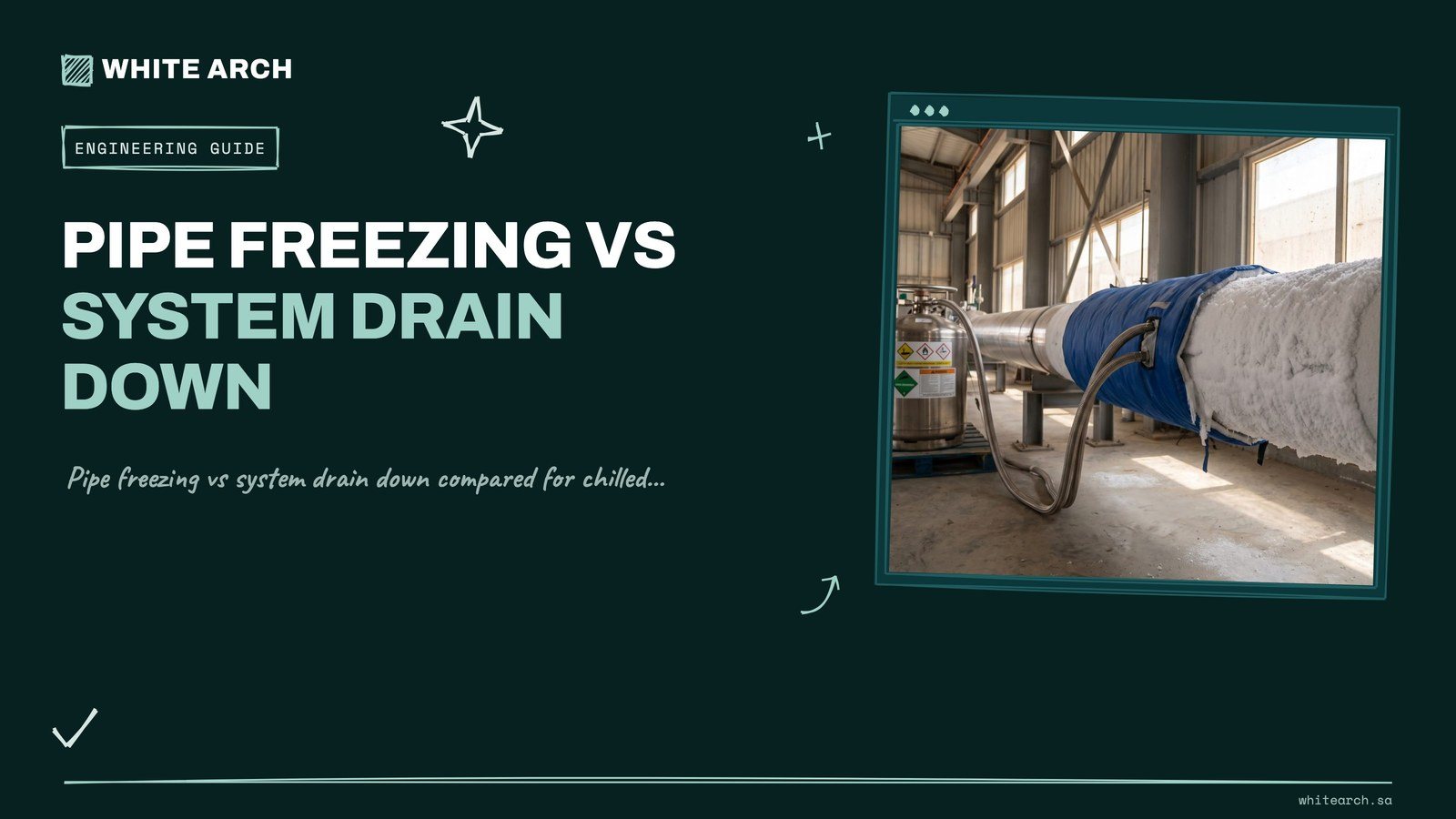
Draining a system stops every user on the circuit and leaves a refill, venting, re-treatment and rebalancing sequence behind it. Pipe freezing isolates only a short section by forming an ice plug with liquid nitrogen, so the rest of the circuit keeps running. It works on water-filled lines where flow can be stopped at the freeze point, and drain-down remains the better choice when the whole circuit is shut anyway and the isolation valves seal.
- Pipe freezing vs system drain down: what each method does
- What is pipe freezing in pipework?
- Where the downtime goes in a drain-down
- How does pipe freezing work?
- Pipe freezing technique for valve replacement
- Pipe freezing vs system drain down: decision table
- Valve replacement without shutdown in Saudi Arabia
- Pipe freezing without draining the system: limits and risks
- How White Arch applies this
Pipe freezing vs system drain down: what each method does
Pipe freezing vs system drain down is the decision that sets how much of a building or plant stops when a single valve has to change. Draining takes the whole circuit out of service, while a freeze plug stops water at one point and leaves the rest running. In a pipe freezing vs system drain down comparison, the useful measure is not the method itself but how much of the system loses service, for how long, and what risk the method adds.
We frame the pipe freezing vs system drain down question around downtime and risk, because those are what facility teams and plant operators feel. A drain-down is simple to specify, but it stops every user on the circuit, hands the team a refill, vent, treat and rebalance sequence afterward, and depends on isolation valves that seal. A freeze avoids that, but it needs flow stopped at the freeze point, a pipe full of liquid, and controls for nitrogen and cold. This guide explains how pipe freezing works, sets out the technique for valve replacement, and shows when each method wins the pipe freezing vs system drain down decision. Our own scope is described on our pipe freezing services page.
What is pipe freezing in pipework?
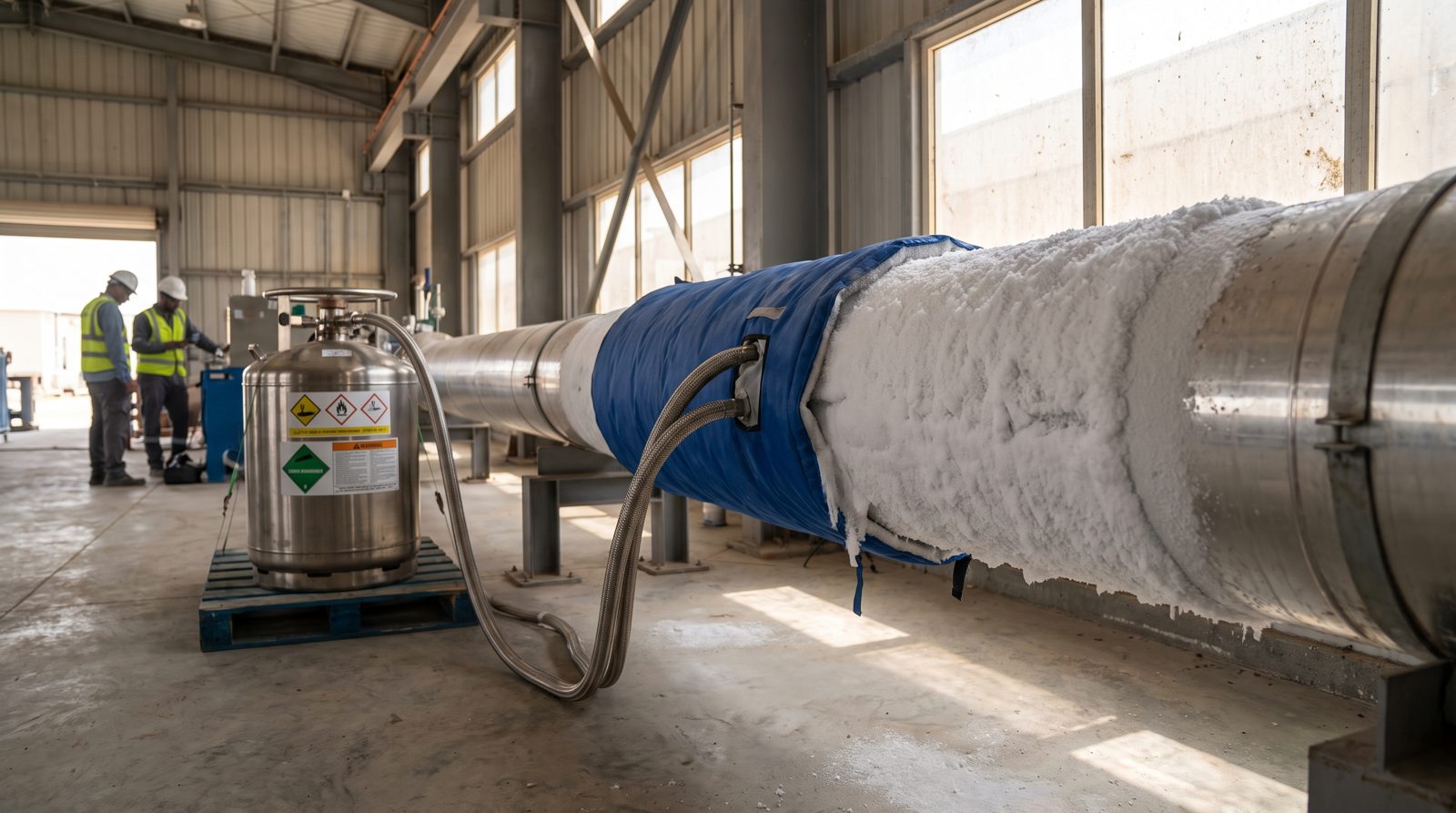
What is pipe freezing in pipework? Pipe freezing in pipework is a cryogenic isolation method. A jacket is clamped around a liquid-filled pipe and fed with liquid nitrogen until the water inside freezes into a solid ice plug that seals the bore. While the plug holds, a valve, strainer or short pipe section can be changed without draining the system. It is not the same thing as a pipe freezing accidentally in cold weather: the freeze is deliberate, placed, monitored and thawed under control.
| Term | Meaning on site |
|---|---|
| Freeze jacket | The insulated sleeve clamped around the pipe that holds liquid nitrogen against the wall |
| Dewar | The vacuum-insulated vessel that stores and supplies the liquid nitrogen |
| Ice plug | The solid plug that forms inside the bore and seals it against line pressure |
| Freeze point | The location on the pipe where the jacket is fitted, clear of welds and fittings |
| Controlled thaw | Letting the plug melt naturally after the nitrogen feed stops, never with flame or direct heat |
Where the downtime goes in a drain-down
Drain-down downtime is longer than the work itself because the work sits in the middle of a sequence. The table shows where the time goes and who is affected at each step.
| Step | What happens | Who is affected |
|---|---|---|
| 1. Isolate and drain | Existing valves are closed and the circuit or a large section is emptied | Every user on that circuit |
| 2. Do the work | The valve or component is changed | Users stay out of service |
| 3. Refill | The circuit is refilled from make-up supply | Users stay out of service |
| 4. Vent air | Trapped air is purged from high points and equipment | Users return in stages, with risk of air locks and poor flow |
| 5. Re-treat the water | Corrosion inhibitor and other chemicals are re-dosed in a closed loop | Water quality is verified before full operation |
| 6. Rebalance and verify | Flows are checked and rebalanced where needed | Final return to design operation |
The volume involved explains why. The table uses the nominal bore as the internal diameter, which slightly overstates the volume because real internal diameters depend on wall thickness.
| Nominal bore | Approximate water per meter of pipe |
|---|---|
| DN50 | About 2.0 liters |
| DN100 | About 7.9 liters |
| DN150 | About 17.7 liters |
| DN200 | About 31.4 liters |
| DN300 | About 70.7 liters |
As an illustration, a chilled-water loop with 500 m of DN200 main holds about 15,700 liters in that pipe alone, before any equipment. A freeze that isolates a valve on that main leaves almost all of it in place. If the work point is 3 m from the plug, only about 94 liters, around 0.6 percent of the main, needs to be drained locally. The same logic applies to condenser water, domestic water and fire lines.
Also read: Cooling Load Calculation for Buildings in Saudi Arabia: Design Conditions and Method
How does pipe freezing work?
How does pipe freezing work? Liquid nitrogen boils at about minus 196 °C, and when it is fed into a jacket around the pipe it draws heat out through the wall far faster than the surroundings can replace it. Ice forms on the inside of the wall first, then grows inward in rings until the bore is closed by a solid plug. The boiled-off gas is vented away from the work area, and the nitrogen feed is maintained for as long as the work lasts. The properties below come from standard physical constants and USDA ARS liquid nitrogen safety guidance.
| Property | Value | What it means on site |
|---|---|---|
| Boiling point of liquid nitrogen | Minus 195.8 °C at atmospheric pressure | Sets how fast heat leaves the pipe wall |
| Liquid-to-gas expansion at 20 °C | About 694 to 1 | Boiled-off nitrogen displaces air, so enclosed spaces need ventilation |
| Latent heat of fusion of water | About 334 kJ/kg | The energy removed to turn water into ice |
| Latent heat of vaporization of liquid nitrogen | About 199 kJ/kg | The heat each kilogram of nitrogen absorbs as it boils |
| Volume increase when water freezes | About 9% | Liquid trapped between two plugs or closed valves can over-pressurize |
Two conditions are essential for the freeze to hold. There must be no flow at the freeze point, because moving water carries heat in faster than the jacket can remove it, and the pipe must be full of liquid, because an air pocket will not form a seal. A 300 mm plug in a 100 mm bore holds about 2.4 kg of water, so freezing it removes about 0.8 MJ of latent heat alone, and real nitrogen consumption is several times the theoretical minimum, which is why quantity is confirmed at survey.
Pipe freezing technique for valve replacement
The pipe freezing technique for valve replacement follows a fixed sequence, and for valve replacement without shutdown in Saudi Arabia each step has a control. The freeze is placed between the water source and the valve, so the plug holds back supply while the valve is out.
| Step | Action | Control |
|---|---|---|
| 1. Survey | Confirm pipe size, material, wall condition, medium, pressure, flow control and access | Written survey record and suitability decision |
| 2. Choose the freeze point | Select clean straight pipe between the source and the valve, clear of welds and fittings | Freeze point marked and agreed with the owner |
| 3. Stop flow | Stop pumps or otherwise bring the section to zero flow | Permit-to-work and operator confirmation |
| 4. Fit the jacket and freeze | Clamp the jacket, connect the dewar and feed liquid nitrogen | Pipe surface temperature monitored until the plug forms |
| 5. Prove the plug | Open a downstream drain or vent and confirm there is no passing flow | No joint is broken until the plug is proven |
| 6. Relieve trapped volume | Vent any section held between two plugs or closed valves | Prevents over-pressure from ice expansion |
| 7. Replace the valve | Change the valve while nitrogen maintains the plug | No impact or shock loading on the frozen pipe |
| 8. Thaw, test and reinstate | Stop the feed, let the plug thaw, leak test and restore flow | Joints checked and records handed over |
Where the valve sits between two possible supply points, two freezes are used, one on each side, with the section between them vented. The same technique applies to strainers, meters and pressure reducing valves, and it is the core of our pipe freezing technique for valve replacement and the wider solutions.
Also read: BTU to Ton Conversion: Sizing Cooling Capacity the Right Way
Pipe freezing vs system drain down: decision table
As a reminder of what is pipe freezing in pipework, it is a deliberate ice plug that is placed, monitored and thawed under control. The table sets pipe freezing vs system drain down side by side on the factors that decide downtime and risk.
| Factor | Drain-down | Pipe freezing |
|---|---|---|
| What loses service | Every user on the drained circuit | Only the section beyond the plug |
| Water to handle | The whole circuit or large section | Only the water between the plug and the work point |
| Water quality and air | Refill, vent and re-treat the whole volume | Local drain and local venting |
| Rebalancing | Usually needed after a large refill | Usually limited to the affected section |
| What it depends on | Isolation valves that seal tightly | Flow stopped at the freeze point and a pipe full of liquid |
| Added risks | Water release, air locks, restart problems | Cryogenic cold, oxygen displacement, trapped expansion, material limits |
| Fire lines | Impairment covers the whole riser or zone | A smaller area and shorter impairment under the same procedure |
| Best fit | A planned shutdown of the whole circuit with sealing valves | A live circuit, a missing or failed valve, or a critical service |
The honest answer to which method gives less downtime is that it depends on the circuit. A freeze takes time to form and to thaw, so for a short run that is already easy to isolate, a drain-down can be quicker. For a large circuit with one failed valve, the freeze usually wins because the outage is confined to a small section.
Valve replacement without shutdown in Saudi Arabia
Valve replacement without shutdown in Saudi Arabia is a routine request wherever stopping the circuit is expensive in operational terms: hospital chilled-water loops, data center cooling, malls that trade every day, and process plants whose utility and fire water networks run continuously. The table shows how isolation is usually approached in each.
| Facility | Why draining is hard | Typical approach |
|---|---|---|
| Hospital chilled-water loop | Cooling cannot be lost to clinical areas | Freeze a branch, keep the rest of the plant running, and sequence work into the lowest-load period |
| Data center cooling loop | Redundancy is limited during any outage | Freeze on a branch with zero flow and agree the fallback isolation point first |
| Mall central plant | Trading hours limit shutdown windows | Night or shutdown-window freeze under the engineering team's permit-to-work system |
| Process plant utility water | Production depends on the circuit | Freeze where possible, and hot tapping or line stopping where the line cannot be stopped |
| Fire main or riser | Protection cannot be left off for long | Freeze a short section under the site's impairment procedure to limit the area and duration |
We carry out this work from Dammam for plants and buildings across the Eastern Province, Riyadh and the Kingdom, and our guides to the MEP contractor in Riyadh and HVAC contractor in Dammam show how it fits into wider packages. Chilled-water plant behind these loops is covered on our chiller installation and replacement page, and the sectors we serve are on our markets page.
Pipe freezing without draining the system: limits and risks
People who search "how does pipe freezing work" usually ask next what it cannot do. Pipe freezing without draining the system is not suitable for every line, and the limits are specific to each installation. The table lists the conditions that must be met and the hazards that must be controlled.
| Condition or hazard | What the numbers say | What we do |
|---|---|---|
| Flow at the freeze point | Moving water carries heat in faster than the jacket removes it | Stop pumps or bring the section to zero flow before freezing |
| Pipe full of liquid | An air pocket will not form a seal | Confirm the pipe is full at the freeze point |
| Pipe material | Cast iron and some plastics are brittle at low temperature, and carbon steel loses toughness at cryogenic temperatures | Assess material at survey and avoid shock loading |
| Medium | Water freezes reliably, while glycol mixtures depend on concentration | Assess each case and choose another method where needed |
| Oxygen depletion | One liter of liquid nitrogen becomes about 694 liters of gas, and as a calculation, boiling about 10 liters in an unventilated 100 m³ room lowers oxygen from 20.9% to the 19.5% OSHA limit | Ventilation, continuous oxygen monitoring and no work in unventilated pits or shafts |
| Trapped expansion | Water expands about 9% when it freezes | Vent any section held between two plugs or closed valves |
Where a line cannot be stopped at all, or the size or medium is unsuited to freezing, hot tapping and line stopping are the alternatives, described on our hot tapping services page. Fire line work follows the building's impairment procedure, and our standards page describes the quality and safety framework we work to.
Also read: VRF and VRV Systems: Advantages, Limits and Where They Beat Conventional AC
How White Arch applies this
We survey every line before recommending a method, and the survey answers how does pipe freezing work for that particular line, including whether it should be drained instead. Where pipe freezing without draining the system is right, and valve replacement without shutdown in Saudi Arabia is possible, we plan it as an engineered isolation with a method statement, oxygen monitoring and a contingency, and we coordinate it with the operations team so the lowest-load period is used. Where it is not, we say so and offer hot tapping and line stopping or a planned drain-down. Teams new to the method often begin with what is pipe freezing in pipework, and the survey answers that for their own line. The same team handles the valve, the pipework and the rebalancing under our HVAC services, so one contractor owns the isolation and the work it enables. Learn more about White Arch, browse our services or read our technical articles.