
Chiller Replacement in Saudi Arabia: Evidence, Refrigerants and Outage Planning
We plan and carry out chiller replacement in occupied buildings: condition evidence, refrigerant transition, selection, temporary cooling, removal, installation and commissioning under one contractor, mobilized from Dammam across the Kingdom.
Request proposal WhatsApp +966 57 048 3020
Chiller replacement is the planned removal of a worn or outdated chiller and the installation of a correctly sized new machine, together with the pipework, electrical, controls and commissioning that make the plant perform as one system. Chiller replacement in Saudi Arabia turns on four decisions: whether condition evidence justifies replacement, which refrigerant the new plant will run on, how cooling continues during the outage, and how the work is sequenced. White Arch delivers the full scope as one accountable contractor.
Chiller replacement in Saudi Arabia: a plant decision, not an equipment swap
Chiller replacement in Saudi Arabia is a plant-level engineering project. A good chiller replacement in Saudi Arabia starts from the building's current cooling load, not the original design brief, and it ends with a commissioned plant whose chillers, pumps, towers and controls are sequenced together. A like-for-like swap carries yesterday's sizing, refrigerant and part-load behavior into the next quarter century, which is the main thing a replacement should avoid.
For facility managers, consultants and developers, the practical questions are how the building stays cool while the old machine comes out, how long the outage window lasts, and which interfaces change: structure, power, chilled-water piping and the building management system. We plan chiller replacement in Saudi Arabia around those questions from our Dammam headquarters, as a chiller installation company in Dammam with Kingdom-wide reach, and we run the mechanical, electrical and controls work as one scope. For anyone weighing chiller replacement in Saudi Arabia against a retrofit, the first step is evidence. This page covers the replacement decision, while our chiller installation and replacement page covers the installation procedure and checklist, and our HVAC services describe the chiller plant design and installation in Saudi Arabia that surrounds a replacement.
Evidence for the replacement decision
Age alone does not decide a replacement, and condition evidence is what an owner or consultant can defend. The table lists the tests we use and what each result points toward.
| Test or record | What it finds | What points toward replacement |
|---|---|---|
| Efficiency trend | kW per ton against the commissioning baseline at comparable load and condenser conditions | A rise sustained over several seasons that maintenance cannot recover |
| Eddy current tube testing | Wall loss, pitting and cracking in evaporator and condenser tubes | Significant wall loss across many tubes, which turns a retube into a replacement question |
| Oil analysis | Wear metals, moisture and acid in the lubricant | Rising wear-metal trends or acid, which signal internal wear or contamination |
| Vibration analysis | Bearing, gear and rotor condition | Rising levels at running speed or at bearing frequencies |
| Motor insulation tests | Winding insulation resistance and polarization index | Low or falling values on hermetic or semi-hermetic motors |
| Refrigerant records | Leak history and top-up volumes | Repeated large top-ups of a refrigerant that is being phased out |
| Controls and parts support | Whether the controller and compressor parts are still supported | Discontinued support from the manufacturer |
Where the tests show one failed component in an otherwise sound machine, repair or retrofit can be the better answer. Replacement is justified when several indicators agree, and the evidence file then becomes part of the consultant's approval package.
Refrigerant transition: HCFC, HFC and lower-GWP options
Refrigerant is now a design decision, not a detail. Under the Montreal Protocol, HCFCs such as R-22 and R-123 are being phased out, and the Kigali Amendment adds a phase-down of HFCs such as R-134a. Saudi Arabia ratified the Kigali Amendment on 10 September 2025, and it entered into force for the Kingdom on 9 December 2025 (International Institute of Refrigeration). As an Article 5 Group 2 party, Saudi Arabia freezes HFC consumption in 2028, takes a first 10 percent step in 2032 and reaches an 85 percent reduction by 2047 against a baseline of average HFC consumption in 2024 to 2026 plus 65 percent of the HCFC baseline (European Fluorocarbons Technical Committee).
The dates matter for chiller replacement in Saudi Arabia because a machine commissioned in 2027 and run for 25 years operates until about 2052, beyond the 2047 milestone. The table lists the refrigerants we meet most often.
| Refrigerant | Type | Safety class | 100-year GWP | Note |
|---|---|---|---|---|
| R-22 | HCFC | A1 | 1,810 (UNEP) | Phase-out under the Montreal Protocol |
| R-123 | HCFC | B1 | 77 (UNEP) | Common in older low-pressure centrifugals, with a phase-out and a toxicity classification |
| R-134a | HFC | A1 | 1,430 (UNEP) | Subject to the Kigali phase-down |
| R-513A | HFC and HFO blend | A1 | About 630 | Lower-GWP alternative for R-134a machines, still contains an HFC |
| R-1234ze(E) | HFO | A2L | Below 1 | Mildly flammable, so machinery room and leak provisions need review |
| R-1233zd(E) | HFO | A1 | About 1 | Low-pressure refrigerant, often used in centrifugal chillers |
| R-514A | HFO blend | B1 | About 2 | Toxicity classification affects room and ventilation requirements |
GWP values for R-22, R-123 and R-134a are from UNEP OzonAction. The other values are approximate and vary by IPCC assessment report, so confirm refrigerant data against ASHRAE 34 and the manufacturer's selection.
Chiller plant design and installation in Saudi Arabia: selecting the new plant
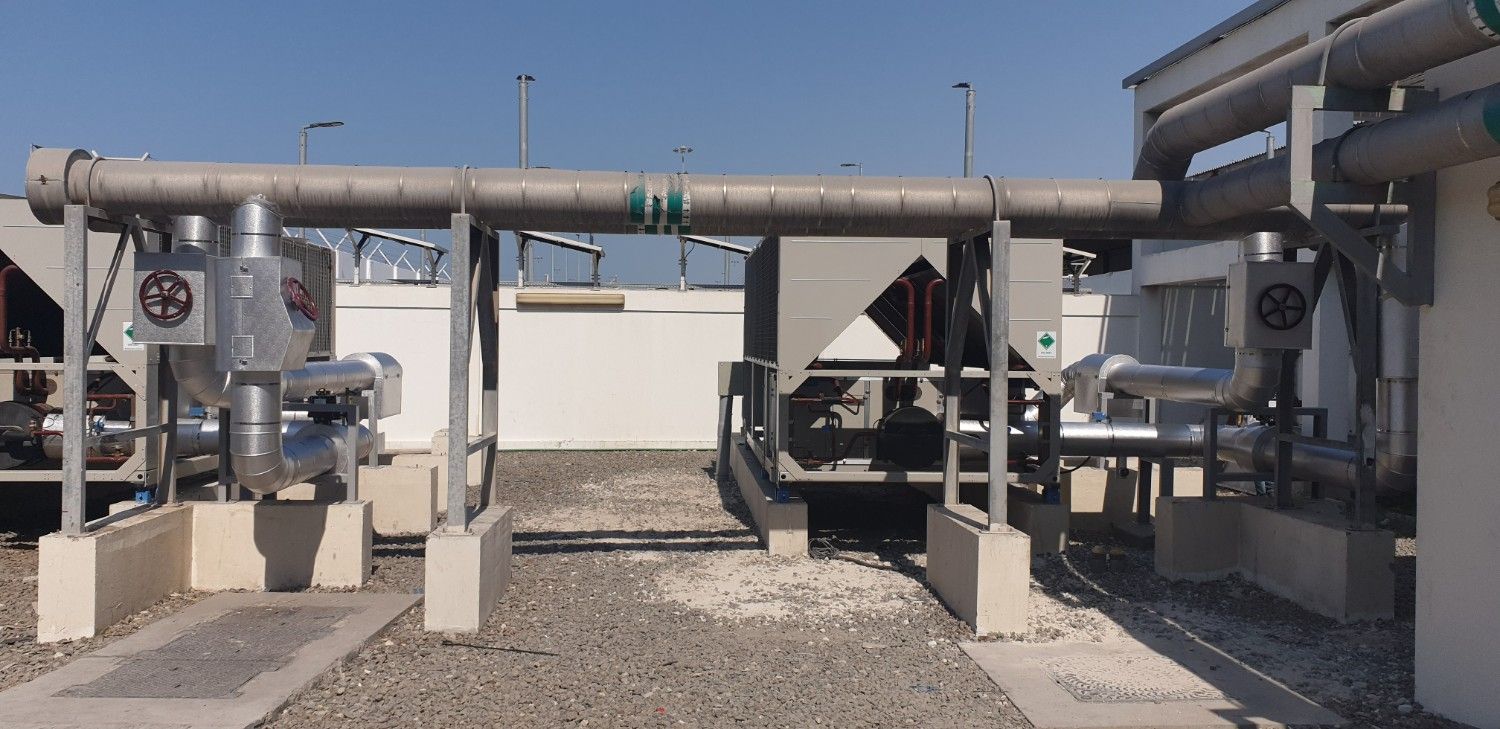
Chiller plant design and installation in Saudi Arabia starts with the load, then the arrangement. Most operating hours sit well below design load: the AHRI 550/590 part-load weighting counts only 1 percent of hours at full load, 42 percent at 75 percent, 45 percent at 50 percent and 12 percent at 25 percent. That weighting is a rating convention, not site data, but it shows why part-load behavior drives energy use. The table lists the decisions we put in front of the consultant, and our BTU to ton conversion guide and cooling load calculation guide cover the sizing arithmetic.
| Design decision | What we evaluate | Why it matters |
|---|---|---|
| Capacity and split | Current peak load from logged data, and how capacity is divided across machines | A split that matches the load profile avoids machines running at low load for most of the year |
| Compressor and drive | Centrifugal with variable speed drive, oil-free magnetic-bearing centrifugal, or screw | Part-load efficiency and starting current on the electrical supply |
| Heat rejection | Water-cooled with towers, or air-cooled, compared in our installation guide | Water use, roof or ground space and high ambient temperature |
| Pumping and temperature difference | Primary-secondary or variable primary flow, and the design temperature difference | Low temperature difference wastes pumping energy and loads chillers poorly |
| Controls | Plant sequencing, staging and BMS points | The plant must perform as a system, not as separate machines |
| Electrical supply | Supply capacity, starters or drives and protection settings | Replacement machines often differ from the originals in current and starting method |
| Code compliance | Minimum equipment efficiency under SBC 601 and the applicable SASO requirements | Confirm against the current editions before selection |
Chiller replacement project timeline
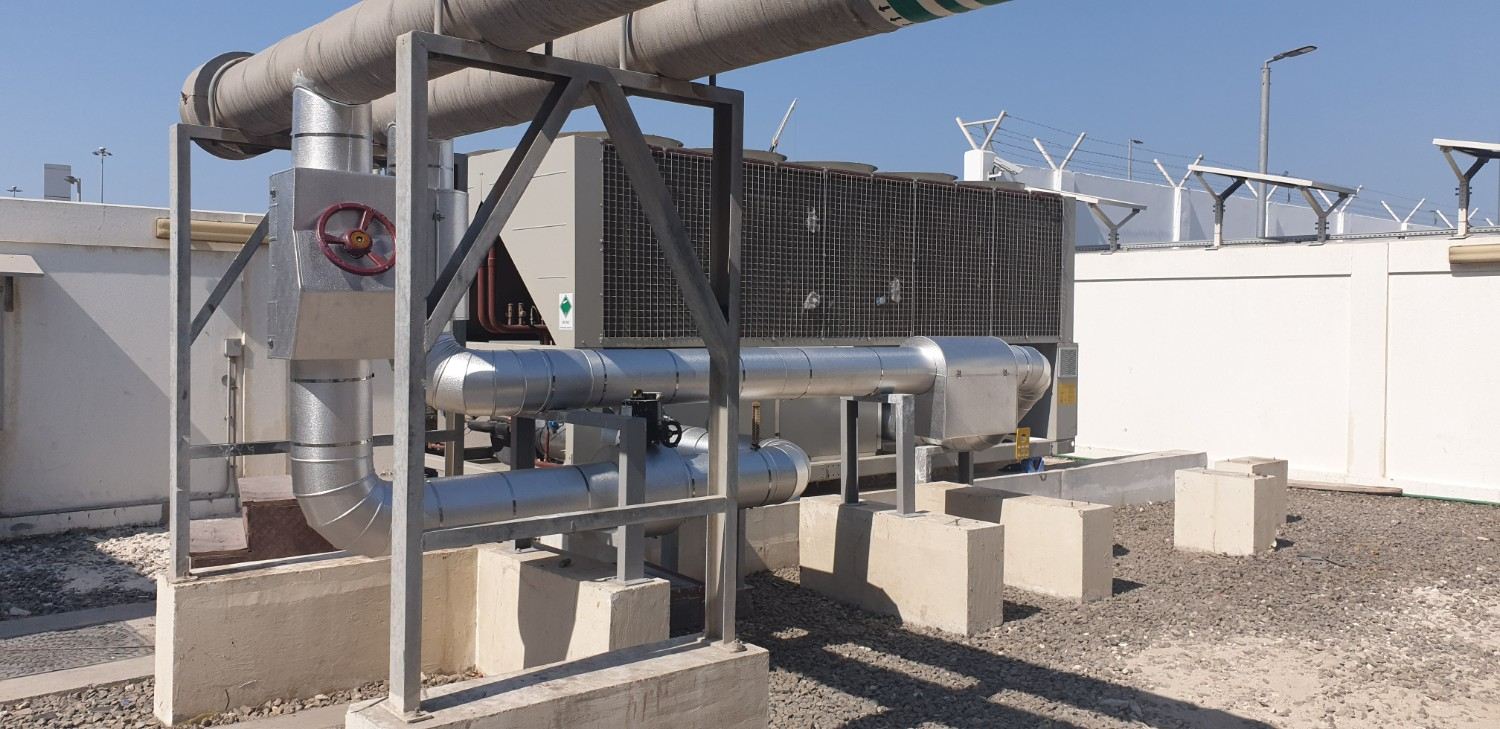
A chiller replacement project timeline is driven by procurement and by the outage window the building can tolerate. The ranges below are planning ranges we use, not guarantees, and the dates are fixed at survey once lead times, access and approvals are known.
| Phase | What happens | Planning range |
|---|---|---|
| Survey | Data logging, condition tests, load review, access and rigging survey | Typically 1 to 4 weeks, depending on plant size and data availability |
| Design and selection | Load confirmation, chiller selection, hydronic and electrical design, consultant approvals | Typically 3 to 8 weeks, depending on approval cycles and design changes |
| Procurement | Manufacture, optional factory witness testing, shipping and customs | Commonly measured in months, depending on manufacturer, capacity, refrigerant and options |
| Temporary cooling | Rental chiller mobilization, temporary power and pipe connections | Days to a few weeks to set up, depending on load, space and power |
| Removal | Isolation, refrigerant recovery, disconnection, dismantling and rigging out | Days to about 2 weeks per machine, depending on the rigging route and structure |
| Installation | Setting, piping, electrical, controls and insulation | Typically 2 to 8 weeks, depending on scope and work-hour restrictions |
| Commissioning | Start-up, performance testing, sequencing, balancing and handover | Typically 1 to 4 weeks, depending on plant complexity and the load available for testing |
Phases overlap. Design continues while condition data is finalized, and removal planning runs in parallel with manufacture, so the on-site outage is much shorter than the full chiller replacement project timeline.
Keeping the building cooled during the outage
Cooling continuity is the central risk. A central chiller plant contractor in Riyadh or anywhere else asks the same first question: how much capacity is spare? A plant with spare capacity can often replace one machine at a time while the others carry the load, provided the work avoids the summer peak in the chiller replacement project timeline. A single-chiller building needs temporary cooling: rental chillers, temporary electrical supply and connection points on the chilled-water headers. Temporary capacity in tons is the load in kW divided by 3.517, which is the same conversion explained in our BTU to ton guide.
New connection points are the usual constraint. Hot tapping and pipe freezing create them without draining the system, as described on our hot tapping services and pipe freezing services pages, and our guide to pipe freezing vs draining the system compares the options on downtime and risk.
Chilled water piping contractor in Dammam: headers, tie-ins and flushing
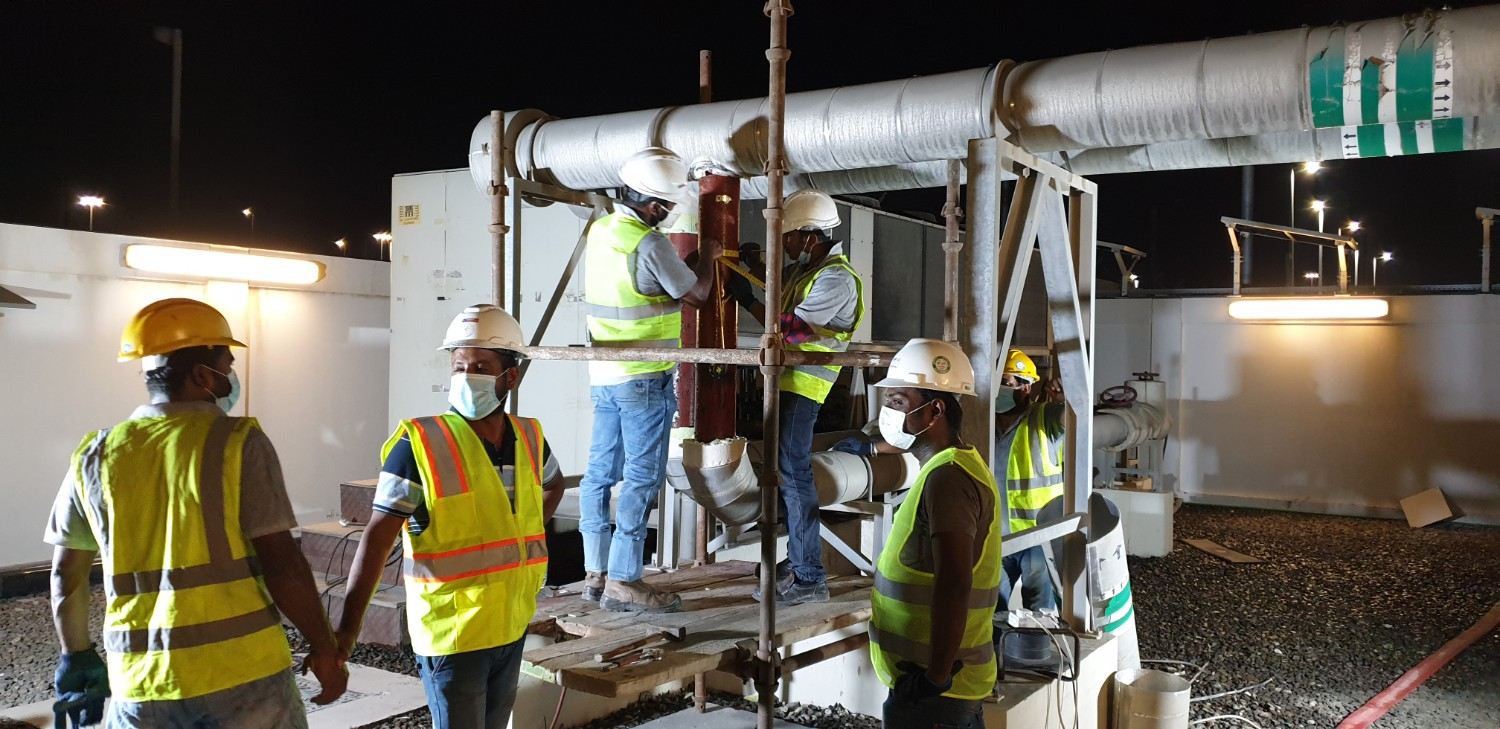
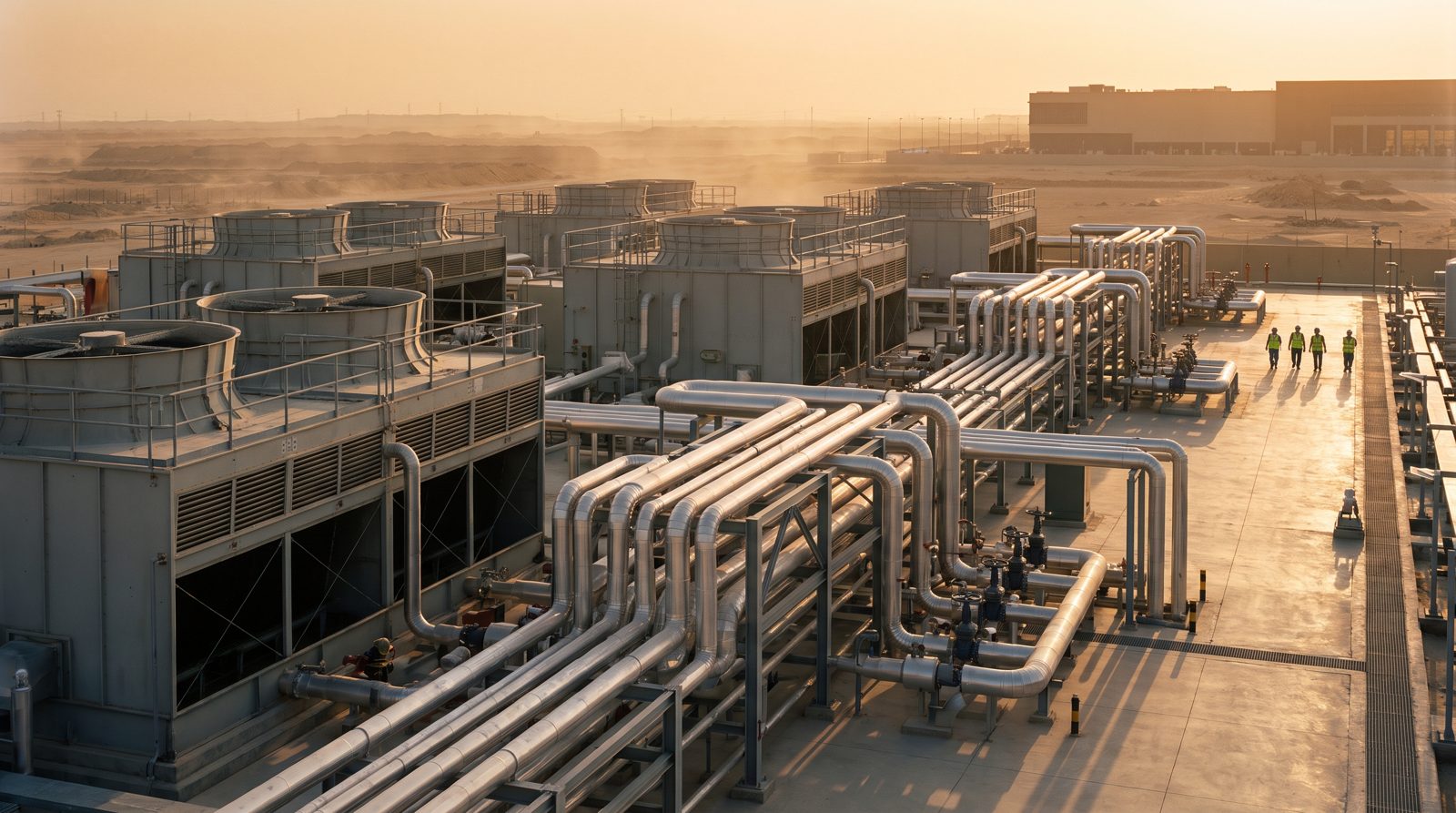
The pipework around a chiller usually outlives the machine, so replacement is also a piping job. As a chilled water piping contractor in Dammam, we modify headers, fit isolation valves where none exist, replace strainers, restore vapor-sealed insulation and flush the loop before the new machine starts. Where condenser water is involved, the cooling tower connections and water treatment are reviewed in the same scope.
| Piping task | Control we apply |
|---|---|
| Header modification | Surveyed tie-in points, with live-line methods where a section cannot be drained |
| New isolation valves | Placed so that the next replacement needs no special isolation method |
| Strainers and instruments | Flow, temperature and pressure points fitted for later capacity checks |
| Insulation | Vapor barrier restored continuously on cold lines |
| Flushing and treatment | Cleaned and treated before the chiller is allowed to run |
Chilled water piping contractor work in Dammam sits within our HVAC contractor in Dammam and MEP contractor in Dammam scopes.
Removal and refrigerant recovery
Removal is controlled work, because the old machine holds refrigerant, oil and a large mass that must leave the building through a surveyed route.
| Step | Control |
|---|---|
| Isolate and de-energize | Permit-to-work, lock-out and verification of isolation before any disconnection |
| Recover refrigerant | Recovered into approved cylinders by certified technicians, never vented to atmosphere |
| Record and reclaim | Recovered mass recorded, and any refrigerant reused is reclaimed to the AHRI 700 purity specification |
| Drain oil and water | Oil and water charges drained and disposed of according to the owner's requirements |
| Rig out | Lift plan checked against the surveyed route and the structure's capacity |
| Handover | Recovery records and disposal documents handed to the owner |
Where we deliver chiller replacement
We replace and upgrade chiller plants for hospitals and cleanrooms, data centers, commercial towers, retail destinations, education campuses and critical facilities, and the markets page lists the sectors in full.
Chiller installation company in Dammam
As a chiller installation company in Dammam, we cover the Eastern Province from our headquarters, including Al Khobar, Dhahran and the Jubail corridor. Enquiries are handled in English or Arabic, and live-line support from our solutions is available on the same contract.
Central chiller plant contractor in Riyadh
As a central chiller plant contractor in Riyadh, we mobilize a dedicated site team from Dammam for replacement, tie-ins and commissioning. See our HVAC contractor in Riyadh and MEP contractor in Riyadh pages for the regional scope, and our services for the full range.
Why clients choose White Arch
As a chiller installation company in Dammam and a central chiller plant contractor in Riyadh, we are one accountable contractor for mechanical, electrical and specialist scopes, with submittals, QA/QC and documented handover. Our standards page describes the quality framework. Learn more about White Arch or read our technical articles.
Frequently asked questions
What does a chiller replacement project timeline look like?
Procurement usually dominates the chiller replacement project timeline, so a program commonly runs several months while the on-site outage for each machine is a matter of weeks. The range depends on chiller size, access, temporary cooling and approvals, and it is fixed at survey.
Can a chiller be replaced without shutting down cooling to the building?
Often yes, either by replacing one machine at a time in a plant with spare capacity or by connecting temporary rental chillers, with hot tapping or pipe freezing used to create connection points without draining the system.
Should the new chiller be the same capacity as the old one?
Not necessarily, because the building load may have changed and the original plant may have been oversized, so capacity should be confirmed from logged data and a current load review before selection.
What happens to the refrigerant in the old chiller?
The refrigerant is recovered by certified technicians into approved cylinders before the machine is dismantled, so that it is not vented to atmosphere. If it is reused, it is reclaimed to the purity specified in AHRI 700, and the recovered mass is recorded.
Which refrigerant should replace R-22 or R-123 in a chiller?
The choice follows the chiller type, the ASHRAE 34 safety class and the Kigali HFC phase-down. Lower-GWP options such as R-1233zd(E), R-1234ze(E), R-513A or R-514A are evaluated for each machine, since the new plant may run for 25 years.
Does the Kigali Amendment affect chiller selection in Saudi Arabia?
Saudi Arabia ratified the Kigali Amendment on 10 September 2025 as an Article 5 Group 2 party, with an HFC freeze in 2028, a first 10 percent reduction in 2032 and an 85 percent reduction by 2047, so refrigerant choice for a plant that will run to 2050 should favor lower-GWP options.
What does chiller plant design and installation in Saudi Arabia involve for a replacement?
Chiller plant design and installation in Saudi Arabia for a replacement covers load confirmation, capacity split, refrigerant, compressor and drive choice, heat rejection, pumping, controls and electrical supply, so the new plant suits today's load.
Does White Arch handle the electrical and controls work as well as the mechanical scope?
Yes, White Arch delivers the chiller, chilled-water piping, LV/MV electrical, starters or drives, BMS integration and commissioning as one coordinated scope with a single point of accountability.
Is White Arch a chiller installation company in Dammam?
Yes. White Arch is a chiller installation company in Dammam, headquartered there, and carries out chiller replacement and installation across the Eastern Province and the Kingdom.
Does White Arch work as a central chiller plant contractor in Riyadh?
Yes. White Arch works as a central chiller plant contractor in Riyadh, mobilizing from Dammam with a dedicated site team for plant replacement, tie-ins and commissioning.
Is White Arch a chilled water piping contractor in Dammam?
Yes. White Arch works as a chilled water piping contractor in Dammam and beyond, covering header modifications, valves, insulation, flushing and live-line tie-ins.
When is the best time of year to replace a chiller in Saudi Arabia?
The cooler months, roughly November to March in most regions, are usually preferred because the remaining plant or temporary chillers carry lower loads, although critical facilities need a temporary cooling plan in any season.
Plan a chiller replacement with one accountable contractor
Send us your scope, drawings or site details. We will review them and respond with a coordinated proposal.
Request proposal WhatsApp +966 57 048 3020Email info@whitearch.sa