
Signs Your Chiller Needs Replacing: Repair, Retrofit or Replace
The main signs a chiller needs replacement are age near or beyond its service life (about 20 to 25 years for water-cooled machines), efficiency that has drifted well above the original kW/TR, dependence on a phased-out refrigerant such as R-22 or R-123, repeated major failures, adverse tube, oil or motor test results, and capacity that no longer matches the building load. When several appear together, replacement or a plant retrofit usually beats continued repair on lifecycle value.
- Signs a chiller needs replacement: why evidence decides
- Chiller life expectancy in a commercial building
- When to replace a chiller: the diagnostic checklist
- Chiller replacement vs chiller repair vs retrofit
- Old chiller replacement energy savings
- How long does a chiller replacement take?
- Building the business case
Signs a chiller needs replacement: why evidence decides
The signs a chiller needs replacement are rarely a single event. A commercial chiller usually declines gradually: efficiency drops, nuisance trips increase, refrigerant top-ups become routine and spare parts take longer to source. Reading the signs a chiller needs replacement correctly is worth the effort because the decision is expensive in both directions. Replacing too early wastes useful asset life, and replacing too late exposes the building to an unplanned failure in the middle of a summer with design ambients around 45 °C, the 1% summer design dry-bulb that Saudi Aramco lists for Dhahran (Saudi Aramco SAES-A-112).
This guide sets out the signs a chiller needs replacement as a diagnostic checklist that facility managers and consultants can work through with their own data, followed by a repair vs retrofit vs replace decision table. Each of the signs a chiller needs replacement below is measurable, so the conclusion can go to finance as an engineering case instead of an opinion. We use the same approach when we assess plants for owners across the Kingdom, and our HVAC services cover the plant types discussed. Knowing when to replace a chiller is also the first step toward a program, which our chiller upgrades and replacement page covers.
Chiller life expectancy in a commercial building
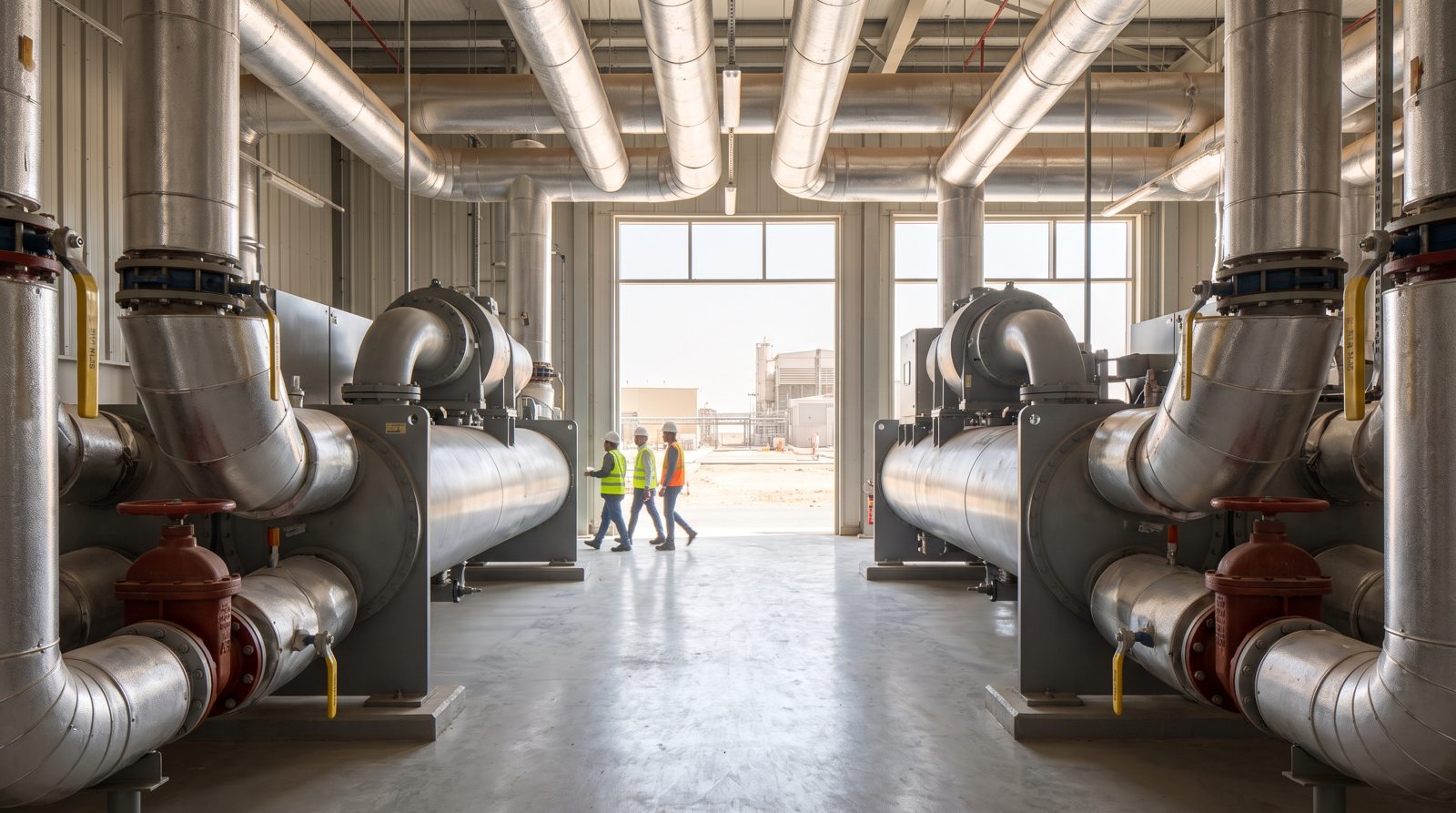
Chiller life expectancy in a commercial building depends on chiller type, duty, water treatment, maintenance history and climate. The reference most often quoted is the ASHRAE equipment service-life data in the Applications Handbook. The 2015 edition summary gives about 20 to 25 years for water-cooled chillers and about 15 years for air-cooled and DX equipment, while the older median chart lists centrifugal chillers at 25 years, reciprocating compressors at 20 and galvanized cooling towers at 20. Figures differ between editions, and they are medians from surveys, not limits.
| Equipment | Commonly cited median service life | Conditions that can shorten it |
|---|---|---|
| Water-cooled centrifugal chiller | About 20 to 25 years | Condenser fouling, poor water treatment, cooling tower carryover |
| Water-cooled screw chiller | About 20 to 25 years | Bearing wear at high lift, oil management problems |
| Air-cooled chiller or DX equipment | About 15 years | High condensing pressure at high ambient, dust on coils, coastal corrosion |
| Cooling tower, galvanized metal | About 20 years | Basin corrosion, poor treatment, scale |
Treat these ranges as approximate and confirm them against the current edition and the manufacturer's guidance. Long cooling seasons, high ambient temperature and salt-laden air in coastal cities such as Dammam, Khobar, Jubail and Jeddah can push equipment toward the lower end of the range, which is why chiller life expectancy in a commercial building on the Gulf coast is best judged from condition data, not age alone.
Also read: Cooling Load Calculation for Buildings in Saudi Arabia: Design Conditions and Method
When to replace a chiller: the diagnostic checklist
When to replace a chiller is easiest to answer with a scorecard. The table lists eight signs with the measurement behind each and a working flag. The flags are our working thresholds for screening, not a standard, so agree them with the consultant for each plant. Two or fewer flags usually point to repair or retrofit, three or four justify an assessment and a capital plan, and five or more usually make a strong case for replacement.
| Sign | How it is measured | Working flag |
|---|---|---|
| 1. Age against service life | Nameplate year against the median for the machine type | Within about three years of the median, or beyond it |
| 2. Efficiency drift | kW/TR against the commissioning or factory baseline at comparable load and condenser conditions | A sustained rise of about 10% or more that cleaning and charge correction do not recover |
| 3. Rising approach temperatures | Condenser and evaporator approach trended against a clean baseline | Approaches that stay high after tube cleaning and charge correction |
| 4. Refrigerant and leak history | Refrigerant type, annual top-up volumes and leak records | A phased-out refrigerant with recurring or large top-ups |
| 5. Condition tests | Eddy current tube testing, oil analysis, vibration, motor insulation and shell inspection | Adverse or worsening results on two or more tests |
| 6. Repeated major failures | Failure and downtime log | Two or more major failures in a short period, or long waits for parts |
| 7. Controls and parts support | Manufacturer support status and communication with the BMS | Discontinued controller or second-hand parts only |
| 8. Capacity versus load | Logged load profile against installed capacity | A plant that is persistently oversized or cannot hold setpoint at peak |
Efficiency drift is the easiest sign to quantify. One ton of refrigeration is 3.517 kW of cooling, so COP equals 3.517 divided by kW/TR, and 0.60 kW/TR is a COP of about 5.9. Our BTU to ton conversion guide, linked below, explains the arithmetic. Approach temperatures matter because the condenser approach is the saturated refrigerant temperature minus the leaving condenser water temperature, and a common rule of thumb is that each 1 K rise in condensing temperature adds roughly 2 to 3 percent to compressor power. The exact figure varies by machine, so use it as a screening estimate.
For condition tests, eddy current testing finds tube wall loss and pitting, oil analysis finds wear metals, acid and moisture, and motor insulation testing tracks winding health. A polarization index below 2.0 is commonly treated as a concern for class B, F and H insulation under IEEE 43. On refrigerants, HCFCs such as R-22 and R-123 are being phased out under the Montreal Protocol, and Saudi Arabia ratified the Kigali Amendment on 10 September 2025, adding an HFC phase-down (International Institute of Refrigeration). A phased-out refrigerant with a leak history is one of the clearest signs a chiller needs replacement, because every repair depends on refrigerant that will get harder to buy.
Chiller replacement vs chiller repair vs retrofit
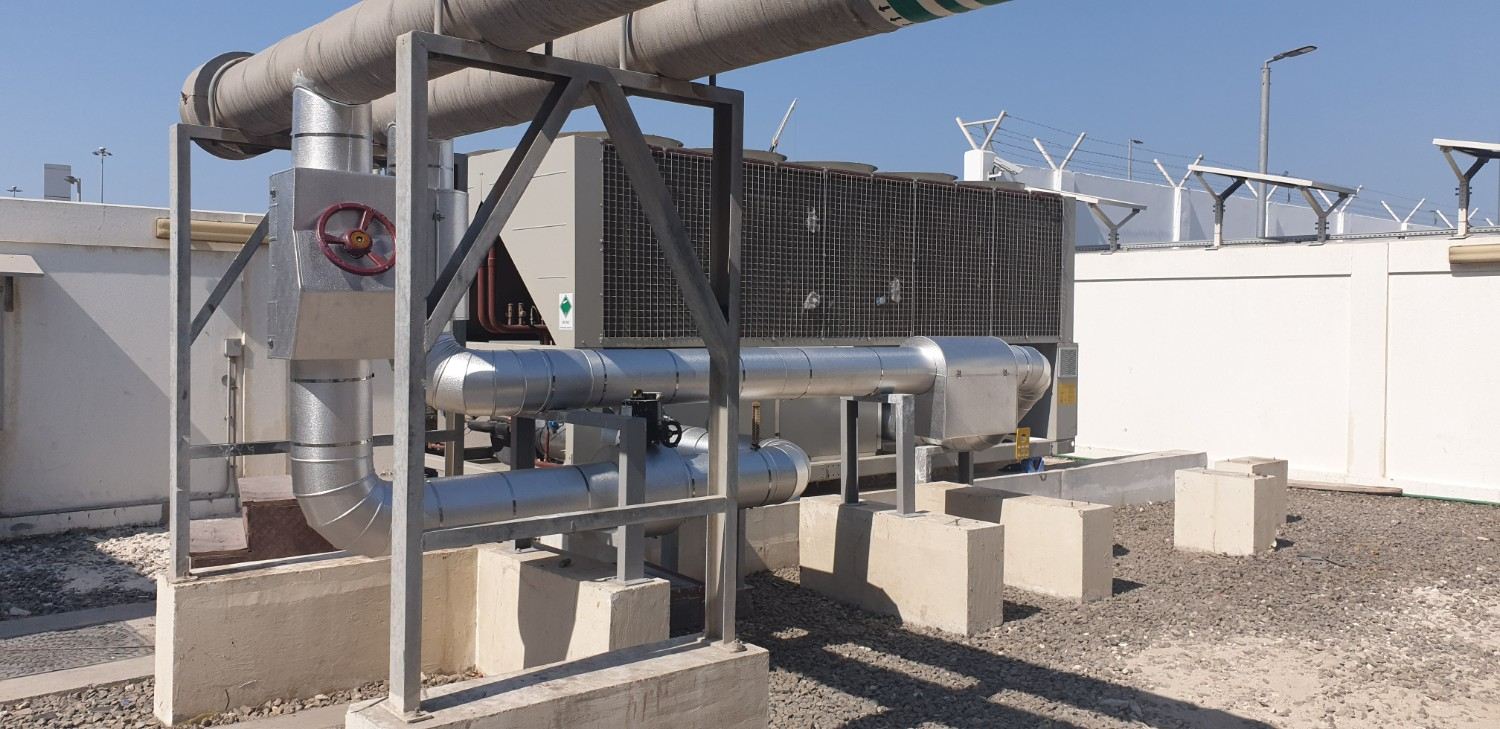
The choice between chiller replacement vs chiller repair is rarely binary. A plant retrofit sits between the two: it keeps sound machines and upgrades drives, controls, pumps and heat rejection around them, as described on our HVAC retrofit page.
| Situation | Repair | Retrofit | Replace |
|---|---|---|---|
| Machine well within service life, isolated fault | Usually right | Consider controls upgrades | Rarely justified |
| Mid-life machine, efficiency drift, sound condition tests | Restore cleaning and charge | Usually right: drives, controls, condenser water optimization | Only if load has changed significantly |
| Near or beyond service life, phased-out refrigerant | Short-term only | Limited value on the chiller itself | Usually right, with plant-level redesign |
| Adverse tube, oil or motor tests plus repeated failures | High risk of repeat spend | Rarely sufficient | Usually right |
| Plant capacity mismatched to current load | Does not address the cause | Possible with capacity split changes | Often right, resized to measured load |
| Critical facility with no redundancy | Necessary to keep running | Add redundancy where possible | Plan with temporary cooling |
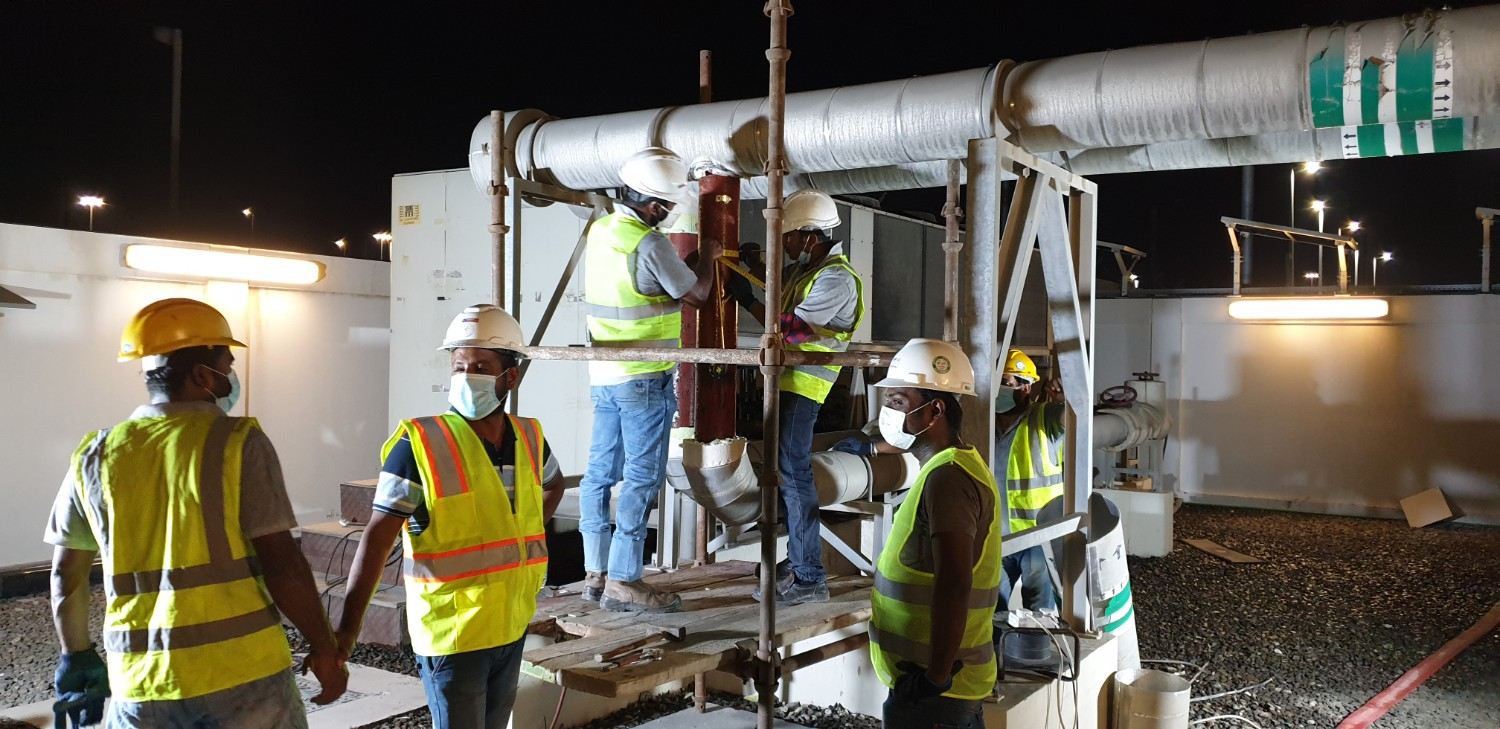
The old chiller replacement energy savings case belongs in the same table as the repair spend it would avoid. Where replacement is the answer in an occupied building, our solutions describe the live-line and critical response capabilities that support it, and our chiller installation and replacement page covers the installation procedure.
Also read: BTU to Ton Conversion: Sizing Cooling Capacity the Right Way
Old chiller replacement energy savings
Old chiller replacement energy savings come from the difference between the existing and new plant efficiency across the real operating profile, not at the full-load rating alone. A simple illustration with assumed numbers shows the method: if an existing machine averages 0.85 kW/TR, a new selection averages 0.60 kW/TR, the average load is 600 TR and the machine runs 4,000 hours per year, the difference is 0.25 kW/TR × 600 TR × 4,000 h, or about 600,000 kWh per year. These inputs are hypothetical, and the real figure must come from logged data, the manufacturer's part-load performance at local condenser conditions and verification after commissioning.
Most chiller operating hours are at part load. The AHRI 550/590 weighting counts only 1 percent of hours at full load, 42 percent at 75 percent, 45 percent at 50 percent and 12 percent at 25 percent, so part-load performance and the plant sequence often matter more than the full-load rating. Pumps, cooling towers and controls should be evaluated at the same time, because a new chiller connected to a poorly controlled plant will not deliver its rated performance. Published Saudi programs show what is possible at building level: a Tarshid university retrofit targeted a reduction of about 25 percent in annual electricity use across 80 buildings, though that program included more than chillers, as our HVAC retrofit page explains.
How long does a chiller replacement take?
How long does a chiller replacement take? It depends on whether it is counted from the decision or from the shutdown. The full program, from survey to handover, commonly spans several months because design approval and manufacturing lead time dominate. The on-site outage for each machine is much shorter, typically weeks, and depends on rigging routes, the extent of piping and electrical changes, temporary cooling arrangements and the commissioning load available. A phase-by-phase table is on our chiller upgrades and replacement page.
Planning steps that reduce risk:
- Start the assessment at least one budget cycle before the expected replacement year.
- Schedule removal and installation in the cooler months where the building allows.
- Use hot tapping or pipe freezing to add connection points for temporary chillers without draining the system.
- Confirm structural, access and power requirements before ordering the new machine.
Also read: Pipe Freezing vs Draining the System: Which Isolation Method Costs You Less Downtime
Building the business case
A replacement case that management will approve combines the checklist findings with lifecycle value, risk and compliance. Finance will ask how long does a chiller replacement take, when to replace a chiller and what the old chiller replacement energy savings will be, so document the asset age, measured efficiency, test results, refrigerant status and failure history, then compare repair, retrofit and replacement over the same time horizon, including downtime risk for the spaces the plant serves. We support facility teams with surveys, condition data review, options analysis and turnkey replacement from Dammam to every region of the Kingdom, including our HVAC contractor in Riyadh and HVAC contractor in Dammam teams. Read more about White Arch, browse our services or see the markets we serve.